The DF-17: China’s Hypersonic Missile and Its Strategic Implications
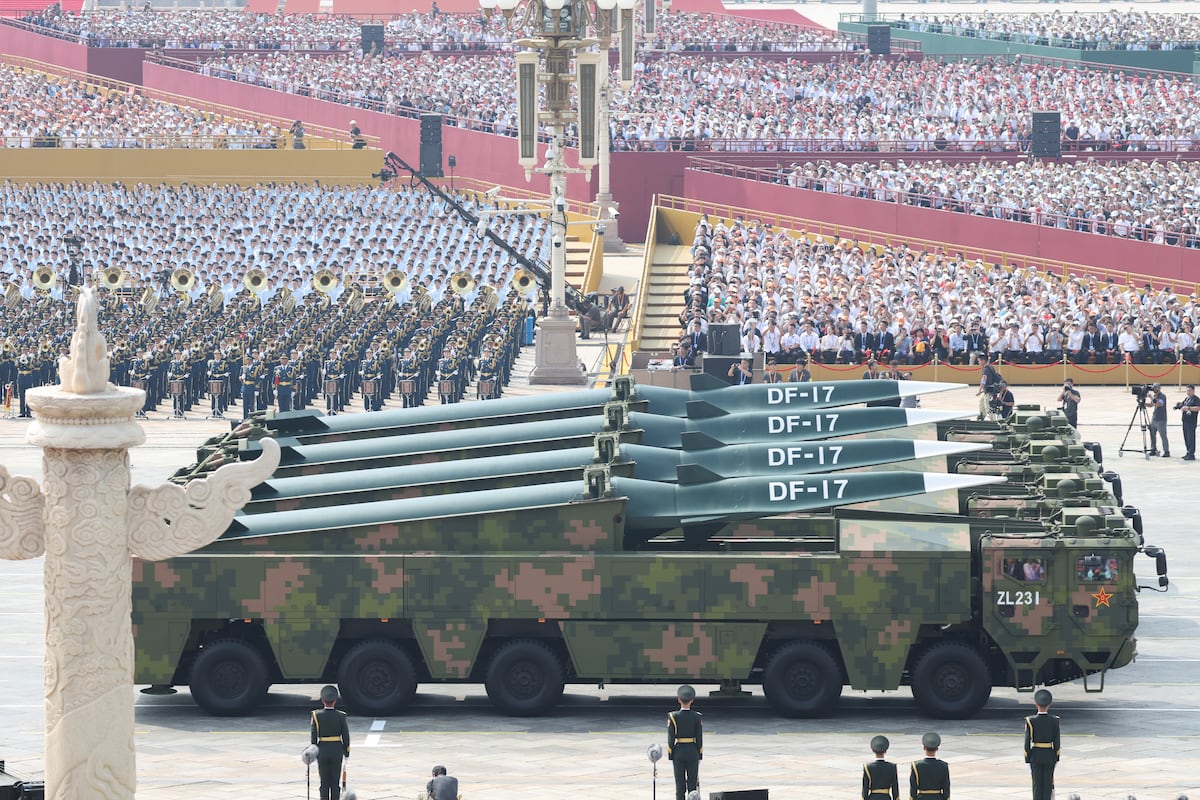
In a recent move that has caught the attention of global military analysts, China has publicly showcased its Dong Feng-17 (DF-17) ballistic missile, a weapon that has been part of the People’s Liberation Army’s arsenal for over a decade. Official Chinese media recently highlighted this missile, emphasizing its battlefield capabilities with English-language subtitles.
Experts note this media reveal is likely a response to military exercises by other Asia-Pacific countries and serves as a warning to the United States military. According to Alexander Huang, chairman of the Council of Strategic and Wargaming Studies in Taipei, “Video footage might be political signaling or mild deterrence, because the DF-17 is very hard to defend against, especially for large surface targets. It’s a big threat to carriers and other assault ships.”
The DF-17 is a medium-range missile equipped with a hypersonic glide vehicle, enabling it to fly at lower altitudes and change directions unpredictably. These missiles have been accessible to the Chinese military since 2019, as stated by the Center for Strategic and International Studies in Washington.
This recent showcasing coincides with the U.S.-led 2026 Rim of the Pacific (RIMPAC) exercises and U.S.-Japan drills, suggesting a strategic timing. Chen Yi-fan, assistant professor at Taiwan’s Tamkang University, believes China aims to demonstrate the DF-17s capability to evade interception and perform “saturation strikes.”
Chen further explains, “This signaling is intended to underscore the PLA’s growing confidence in its capacity to overwhelm regional missile‑defense systems and complicate operational planning” by adversaries. The missiles, as depicted in a YouTube video by CGTN, can conduct “ultra-precise” strikes and “penetrate advanced defense systems” (video).
The DF-17 is described as being 11 meters long, with a range of 1,800 to 2,500 kilometers, capable of carrying either conventional or nuclear payloads. With China possessing 1,300 missiles and 300 launchers, these weapons are deemed significant strategic assets.
M. Taylor Fravel, Security Studies Program Director at MIT, highlights the maneuverability of the DF-17, stating, “This maneuverability means that it is much harder to defeat than a ballistic missile without a hypersonic glide vehicle. It can more easily penetrate missile defenses.”
Given its capabilities, the DF-17 could be reserved for critical scenarios, such as foreign military intervention supporting Taiwan’s independence, according to Chen. As tensions rise in the region, U.S. military bases in Hawaii, Guam, and Japan are closely monitoring Chinese military activities.
In response, the U.S. is advancing its own hypersonic technologies, including the Long-Range Hypersonic Weapon missile system. Chen emphasizes the urgency, stating, “Washington must accelerate the development and deployment of its own hypersonic weapons to establish credible mutual deterrence.”