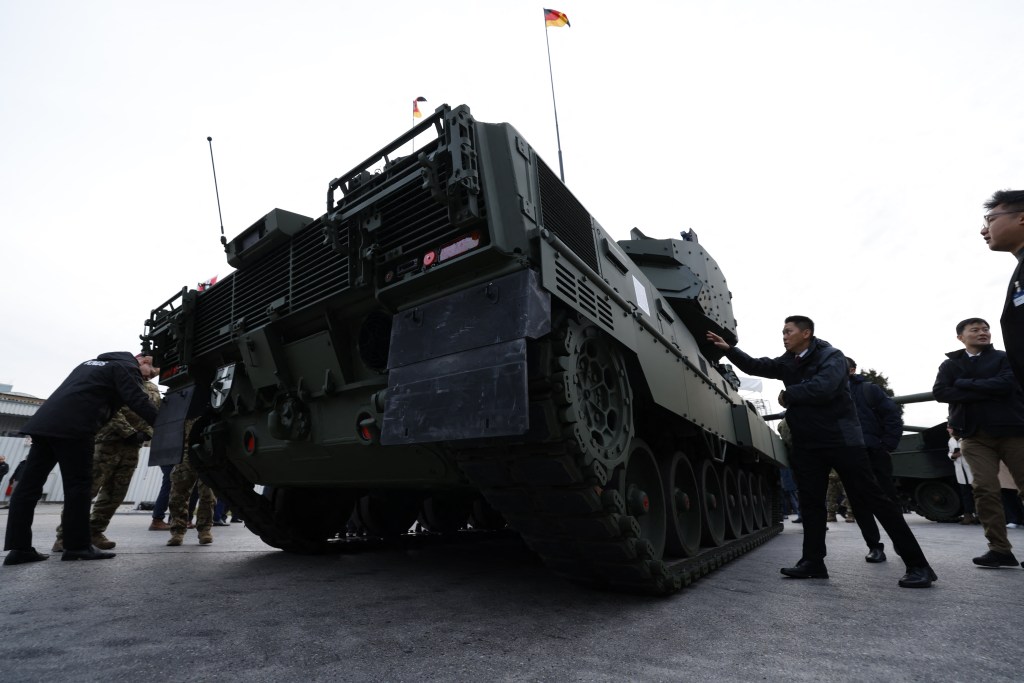
Norway and Germany Strengthen Defense Ties with New Tank Production
In a significant development for European defense collaboration, German tank manufacturer KNDS and Norway’s Ritek have commenced the production of Leopard 2A8 tanks in Levanger, Norway. This move not only solidifies a growing industrial partnership but also integrates into a broader security framework involving submarines, missiles, and military operations in Northern Europe.
Production at the newly established facility began on October 15, with plans to construct 37 of the 54 tanks ordered by the Norwegian Army, as confirmed by KNDS. This facility, which took 18 months to set up, can produce up to 36 tanks each year, marking a significant industrial milestone.
The commencement of tank production follows the inauguration of manufacturing and testing facilities in late April. This undertaking is part of an existing procurement agreement rather than a new acquisition, emphasizing the continuity of the partnership.
The industrial collaboration is a facet of the Hansa Arrangement, a comprehensive agreement formalized in February between Norway and Germany. As outlined by Norway’s Defense Ministry, the agreement prioritizes maritime operations, combined-arms land warfare, rapid reinforcement, defense industry cooperation, and space-based surveillance and communications. More details can be found in the official readout.
A key example of the partnership’s depth is the ongoing submarine cooperation, with both nations planning to operate six identical Type 212CD submarines. This collaboration extends to personnel training and maintenance facilities at Haakonsvern, near Bergen. Additionally, Germany and Norway are jointly working on the next-generation 3SM maritime strike missile.
The partnership goes beyond industrial cooperation, as demonstrated by Germany’s contribution of approximately 1,800 troops to Norway’s Cold Response exercise in March. Ongoing discussions also focus on the potential pre-positioning of German equipment on Norwegian soil.
Research from the Norwegian Institute of International Affairs suggests that the partnership between the two nations gained momentum following Russia’s full-scale invasion of Ukraine in early 2022. Moreover, Germany’s increasing reliance on Norwegian gas has heightened its interest in protecting offshore infrastructure, as explained by researcher Øyvind Svendsen in his analysis.
Germany’s military is increasingly focusing on the North Atlantic, highlighted by the deployment of the new P-8A Poseidon aircraft to monitor the GIUK gap—a strategic passage for Russian nuclear submarines. German Defense Minister Boris Pistorius confirmed that these aircraft will operate from Norwegian and Icelandic bases, as reported by Defense News.
Space cooperation is another important focus. During a visit to Andøya in March, Pistorius emphasized the potential of a joint imaging-reconnaissance satellite constellation, as noted by the German Defense Ministry.
In April, both countries agreed to form a bilateral space working group to explore launch capabilities, space-based surveillance, and secure communications. Norway’s spaceport on Andøya, ideal for launching satellites into polar orbits, plays a crucial role in this collaboration.
Beyond these initiatives, Norway and Germany are also collaborating under various frameworks, such as the Multinational Multi Role Tanker Transport Fleet, which utilizes Airbus A330 MRTT aircraft, and the EU HYDEF initiative, which focuses on developing a European hypersonic interceptor missile.