Arizona’s push towards solar energy faces significant hurdles as state officials and congressional Democrats urge the federal government to reinstate crucial funding for solar initiatives targeting low-income areas. The termination of these funds has sparked a political showdown centered around the Solar for All program.
A letter addressed to both the White House and EPA Director Lee Zeldin from Arizona’s Democratic leadership describes the cessation of the Solar for All program as a breach of federal regulations, asserting that it undermines Congress’s fiscal authority.
The Solar for All initiative, part of the Inflation Reduction Act approved under President Joe Biden, allocated $7 billion to fund solar power installations across 900,000 homes. Arizona was set to receive $156 million, while the Hopi Tribe was awarded $25 million to address electricity shortages in their community.
Canceled Program
Earlier this month, Zeldin announced the discontinuation of the program, attributing the decision to constraints imposed by a previous tax and immigration bill passed under the Trump administration. “EPA no longer has the authority to administer the program or the appropriated funds to keep this boondoggle alive,” Zeldin stated in a social media video on August 7.
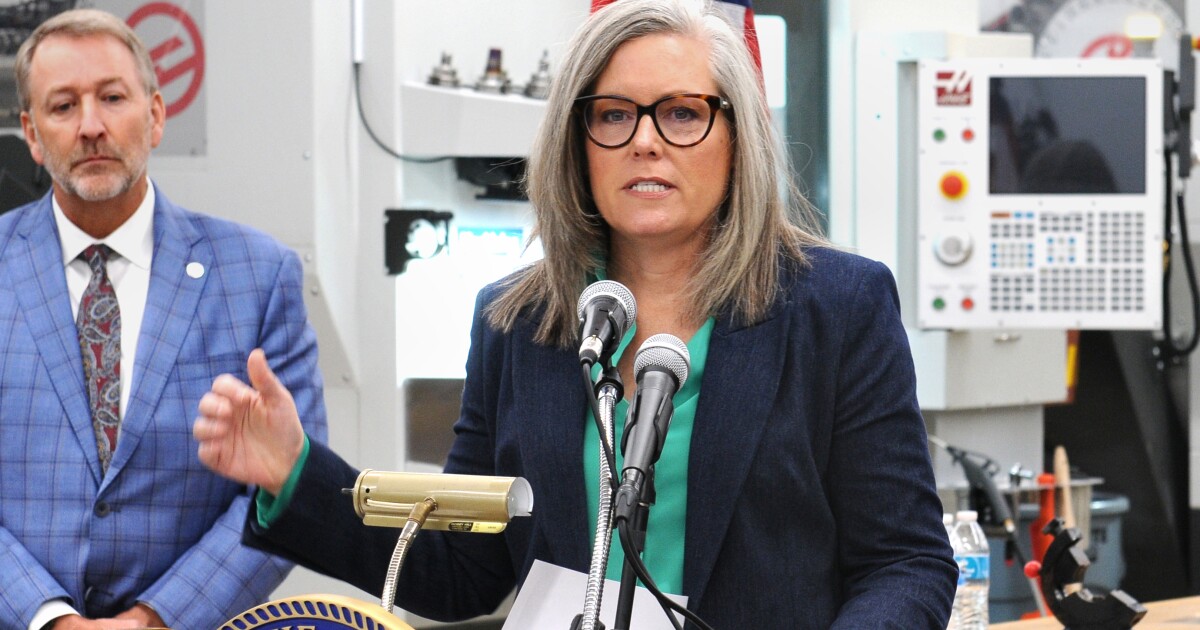
Arizona’s Democratic officials, including Gov. Katie Hobbs, Sens. Mark Kelly and Ruben Gallego, and Reps. Greg Stanton and Yassamin Ansari, expressed their dissent in a letter. They argued that the funds remain obligated and referenced a Congressional Budget Office analysis indicating that only $19 million could be reclaimed under the new bill, primarily administrative costs.
The Democrats warned that canceling the program could halt ongoing projects and squander taxpayer investments.
In response to queries about the potential illegality of rescinding the grant funding, an EPA spokesperson stated, “EPA is reviewing the letter and will respond through the appropriate channels.”
Boon or Boondoggle?
Director Zeldin criticized the program for being inefficient, citing substantial overhead costs. “With all of the middlemen taking their own cut; at least 15% by conservative estimates,” he remarked.
He also claimed that many projects funded by the program were still in their infancy. However, Arizona Democrats contradicted this, asserting that many recipients had already commenced vital projects.
The Arizona Governor’s Office of Resiliency had aimed to use the $156 million grant to significantly boost the state’s rooftop solar capacity from 7 megawatts to 61 megawatts by 2026.
Solar in Flux
The withdrawal of these grants is part of a broader trend affecting Arizona’s clean energy landscape. Arizona Public Service recently reversed its commitment to achieving 100% clean energy by 2050, opting instead for increased natural gas investments. Concurrently, state regulators are moving to repeal renewable energy mandates for utilities.
Additionally, utility regulators have upheld an extra fee for APS customers utilizing solar panels, further complicating the adoption of solar energy.
Amid rising energy demands, Rep. Gallego emphasized the need for rapid energy deployment, stating, “I think we need to be putting as much energy as fast as possible online — renewables are the fastest you can do right now.” He advocated for a balanced approach, suggesting natural gas as a temporary measure to facilitate a transition to more sustainable energy sources.
Gallego noted the importance of diverse energy solutions, including nuclear power, to meet future demands. “And it’s not going to be done by gas pipelines and won’t just be done by solar rooftops,” he concluded.