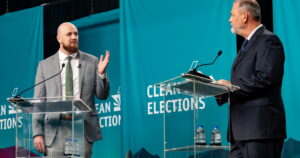
After more than a year of legal disputes, the Maricopa County Board of Supervisors and Recorder Justin Heap have come to an agreement to settle their ongoing conflict over election administration responsibilities. This resolution aims to provide clarity and stability in the county’s electoral process.
The agreement, approved by the supervisors on Tuesday, largely maintains the current division of election duties. The Recorder’s Office will oversee early voting, while the Maricopa County Elections Department, under the supervision of the board, will manage Election Day activities and emergency voting.
County Manager Jen Pokorski confirmed that Heap has already agreed to the settlement.
Board of Supervisors Chair Kate Brophy McGee voiced her satisfaction with the resolution, emphasizing the goal of ensuring a seamless and worry-free voting experience for county residents.
“This agreement lets us do what I have wanted to do since I took office: make Maricopa County boring again — have elections that nobody worries about, has anxiety attacks about, has to ask about, but make sure that their vote is counted,” Brophy McGee stated.
The settlement coincides with the early voting period for the July 21 primary, which remains unaffected by the new arrangement.
An interim election plan, sanctioned by the Arizona Supreme Court earlier this month, will guide the primary election, incorporating various measures to prevent disruptions.
The case between Heap and the supervisors is ongoing. Stay tuned for updates.
The legal battle began when Heap filed a lawsuit accusing the board of unlawfully removing certain powers from his office, as defined by state law. This conflict prompted a series of legal victories for Heap, including a ruling that restored his office’s IT personnel and systems, upheld by the Arizona Supreme Court.
As part of the settlement, the board will allocate up to $21 million from county funds to the Recorder’s Office. These funds will be used to acquire new equipment and expand the IT and early voting staff.
A substantial portion of the funding, approximately $15 million, is earmarked for the development of new IT systems for the Recorder’s Office, moving away from the shared voter database currently utilized by both departments.
Attorney Kory Langhofer, representing the board, explained, “And until the recorder deploys his new system, he gets to keep using the old system. As long as that happens, as long as you’re using the old one jointly, you’ll co-own that.”
Under the agreement, the Recorder’s Office retains control over several key responsibilities, such as voter registration, signature verification, and the issuance of early ballots. Additionally, it will manage all aspects of early voting, including the training of election workers and selection of voting sites.
However, the supervisors will continue to oversee early election boards, which handle early ballot processing, a responsibility they reclaimed in a 2025 agreement with former Recorder Stephen Richer.
The board will also maintain oversight of Election Day operations and emergency voting, as well as the counting of all ballots, excluding those from military and overseas voters.
While the board argued that Heap’s demands contradicted state law and could lead to confusion, the settlement has addressed most concerns, according to Supervisor Thomas Galvin. “It’s not perfect, but overall it provides certainty for how we move forward in running elections, and I’m all about moving forward,” Galvin commented.
Supervisor Steve Gallardo, the board’s sole Democrat, opposed the settlement, citing concerns over Heap’s staffing decisions and his association with America First Legal, a firm involved in the litigation.
“So how can folks in Maricopa County have faith in this recorder and his staff that they’re not going to put their thumb on the scale when it comes to conducting our election, that we’re going to have fair, transparent elections?” Gallardo questioned.
Judge Christopher Coury played a crucial role in facilitating the agreement, serving as a mediator during intense negotiations to resolve the dispute.
Board Vice Chair Debbie Lesko praised Coury’s efforts, noting, “I really believe Judge Coury went above and beyond staying till late last night to try to get this done.”
Under the terms of the settlement, Coury will continue to serve as a “special master,” overseeing any future disagreements.
The agreement awaits final approval from Maricopa County Superior Court Judge Scott Blaney, who presided over the lawsuit.