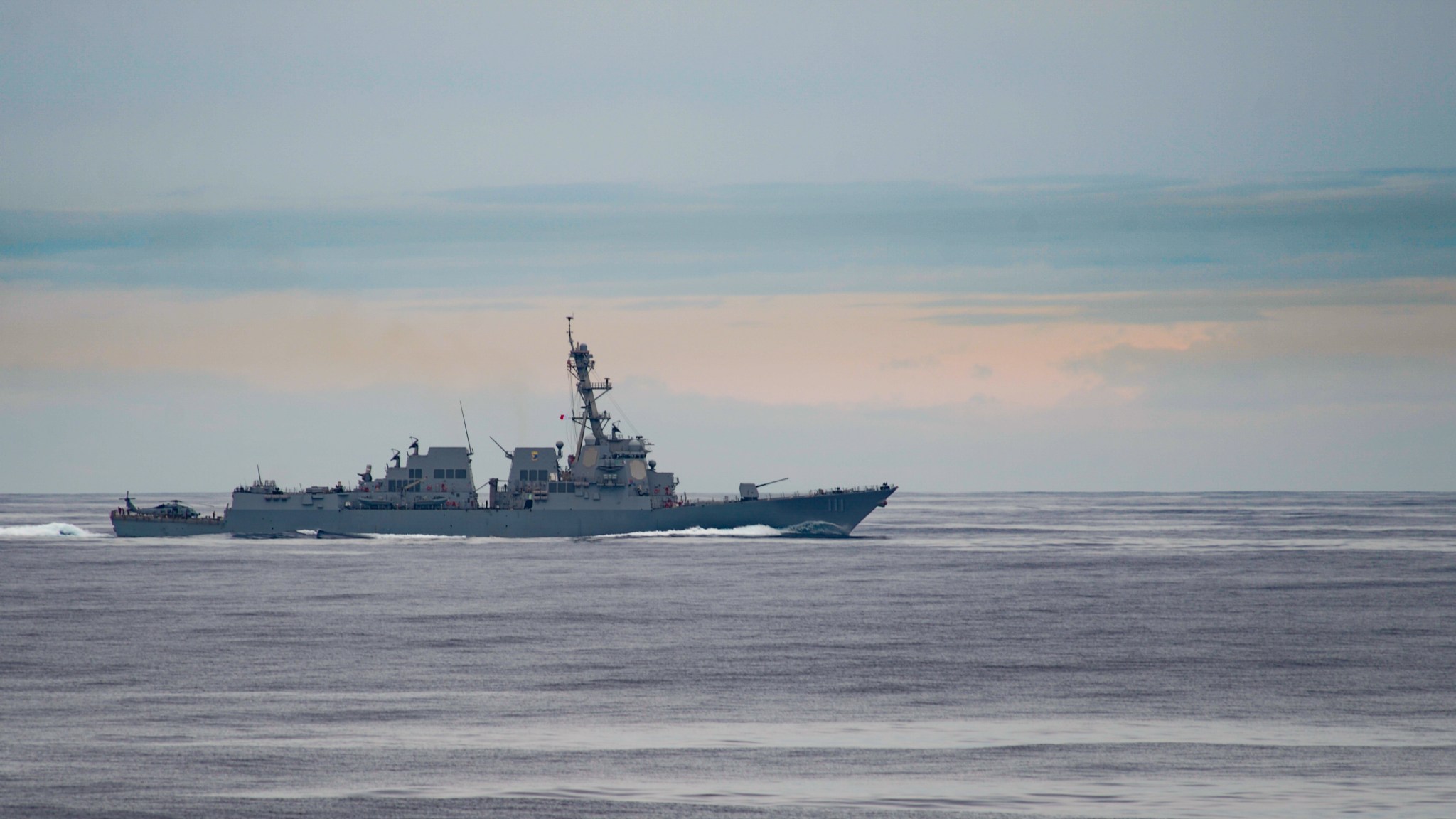
A U.S. Navy warship has been at sea for nearly a year — longer than any American destroyer since World War II — and the consequences are rippling outward to affect families, sailors, and the nation’s ability to keep its fleet ready for future conflicts. The USS Spruance’s extraordinary deployment is shining a spotlight on a maintenance system already under severe strain.
The Arleigh Burke-class destroyer departed Naval Base San Diego on November 21, 2025, as part of the USS Abraham Lincoln carrier strike group. As of October 29, the ship had been underway for 342 days — well past the Navy’s commonly cited seven-month deployment benchmark for U.S.-based ships. The Lincoln has since returned home. The Spruance has not.
Families Left Waiting
For the families of Spruance’s crew, the extended deployment has meant months of delayed homecomings and shifting timelines. Marie Bailey, whose husband serves aboard the ship, described an experience shared by many military families: repeated assurances of an imminent return, followed by more waiting.
“We are hearing they’re supposed to come home sometime next month, but we’ve been hearing about ‘next month’ for several months,”
Bailey told Military Times.
The emotional toll compounds with every extension.
“We don’t know what to expect anymore, but it’s hard getting your hopes up time and time again,”
Bailey added.
“Most of the families are just worried about their sailors, knowing how long they’ve been gone.”
Some sailors aboard Spruance have also expressed frustration that their service has gone largely unrecognized compared to the widespread attention given to the USS Abraham Lincoln. Two crew members, speaking anonymously due to fear of reprisal, pointed out that life on a destroyer carries its own hardships regardless of the ship’s size or public profile.
“It’s tight, cramped and just as challenging on the destroyers, if not more than bigger ships,”
one sailor said.
Another sailor emphasized that the families left behind matter equally, whatever ship their loved ones serve on.
“Our boat isn’t as big as an aircraft carrier, but our 300+ families matter to us just as much as anyone else’s,”
the sailor said.
The Spruance is not alone in facing an unusually long deployment. According to Defense One, the USS John Finn, USS Mustin, and USS Rafael Peralta have all had expected return dates pushed from 2026 into 2027, with some stretching beyond 14 months at sea.
A Maintenance System Under Pressure
The Navy’s Optimized Fleet Response Plan structures destroyer operations on a 36-month cycle, allocating roughly eight months for depot-level maintenance, 10 months for training, and 18 months for deployment and sustainment. When deployments run far beyond that framework, the downstream effects — delayed maintenance, compressed training windows, reduced readiness — can take years to correct.
The Government Accountability Office has documented the Navy’s maintenance struggles extensively. A February 2025 GAO report found that private ship repair companies took nearly 10,000 days longer than planned, cumulatively, to repair destroyers between fiscal years 2015 and 2022. By August 2022, the Navy’s surface-ship maintenance backlog had reached $2.3 billion in deferred work.
A May 2022 GAO report identified a nearly $1.8 billion backlog in depot-level maintenance — roughly $1.7 billion of which involved surface ships. About $1.2 billion was tied to ships the Navy had proposed for early decommissioning. GAO concluded that maintenance backlogs contributed to the retirement of nine ships before their planned end of service.
A separate GAO analysis of 10 surface-ship classes between fiscal years 2011 and 2021 found that maintenance cannibalizations, casualty reports, and depot-level delays all increased during that period, while the hours ships spent at sea declined and costs per steaming hour rose.
A December 2025 Congressional Budget Office analysis found that destroyer and amphibious ship maintenance takes 20% to 100% longer than the Navy plans for. Across a destroyer’s planned service life, roughly nine years — about one in every four — is expected to be spent in maintenance.
GAO also found that the Navy received nearly $25.9 billion for combat surface-ship maintenance from fiscal years 2020 through 2023, approximately $1 billion more than requested, and obligated 99.7% of those funds by the end of fiscal 2023. Despite that level of funding, shortages of spare parts and qualified maintenance personnel, along with deferred work, continue to constrain the schedule.
Senior Navy Leaders Sound the Alarm
The nation’s top Navy officer has been direct about the consequences of the current operational pace. Chief of Naval Operations Adm. Daryl Caudle warned on October 26 that the effects of record-length deployments will reverberate through the fleet’s maintenance pipeline for years to come.
“You’re talking hundreds of availabilities and millions of dollars. Hundreds of millions of dollars have to be applied to that problem as we start retrograding these destroyers back into their maintenance period,”
Caudle said, speaking at the United States Navy Memorial.
“But this is a years-long recovery,”
he added.
“There is no workaround on that.”
Rear Adm. Kavon Hakimzadeh, commander of Norfolk Naval Shipyard, echoed those concerns in September, warning that the sheer volume of destroyers returning from the Middle East would test the physical capacity of American shipyards.
“There’s some choke points just based on capacity out there for all the destroyers that are going to be coming back,”
Hakimzadeh said at a roundtable hosted by the Center for Maritime Strategy.
“We’re running the destroyers really hard out there, and I suspect they’re all going to need to go into the same dry dock, and we’re going to have to sequence them in.”
What the Budget Documents Reveal
Navy budget documents show that the planned timing of Spruance’s next maintenance period has already shifted significantly. The fiscal year 2025 budget originally scheduled a restricted availability — a period when a ship is taken out of normal operations for repairs — from July 3, 2026, through February 21, 2027. The fiscal year 2027 budget shifted that window to January 19 through April 28, 2027 — pushing the start date back by 200 days and the planned completion by 66 days.
Maintenance challenges extend to the sailors themselves. A September 2024 GAO report surveying personnel aboard 232 Navy ships found that 63% of executive officers said it was moderately to extremely difficult for their crews to complete repairs underway with their assigned sailors. Seventy-five percent reported that sailors found it moderately to extremely difficult to complete repairs at all. GAO also found that the Navy did not track how many sailors assigned to ships were unavailable for duty.
Until Spruance returns and undergoes a post-deployment assessment, the full cost of its record-breaking deployment to the ship’s long-term readiness remains unknown. What is already clear is that the Navy’s shipyards, maintenance budgets, and the families of those who serve are all carrying the weight of an operational tempo that has pushed the fleet to its limits.