In a surprising turn of events, a suburb of Phoenix has decided to abandon its initiative of redirecting purified wastewater directly to residential taps. This decision came after political figures raised concerns, labeling the water as contaminated “poop water,” despite a lack of evidence to support these claims.
Scottsdale, a wealthy city, predominantly relies on repurposing its purified wastewater to replenish aquifers, which serve as backup water sources during shortages. Recently, however, the City Council chose to replace the recycling program’s budget with a broad $100 million fund aimed at exploring alternative water supplies.
The recycling program has turned into a contentious issue within the city’s upcoming Council elections. Among the candidates, one advocates for integrating purified wastewater into the drinking system, while others express skepticism, questioning the safety and financial implications of adhering to new state regulations.
City authorities argue that descriptions of the system as “toilet to tap” or “untested poop water” undermine the scientific validity of the program. Officials clarified that less than 1% of the city’s treated wastewater originates from toilets.
The budgetary decision effectively halted plans to incorporate the treated wastewater, which surpasses federal drinking water standards, into the municipal water supply by 2027.
Experts and some residents have expressed concerns that this shift in budget priority, coinciding with a council majority seemingly opposed to recycling wastewater, might compromise the city’s resilience, especially as the West grapples with drought-induced water cutbacks from the Colorado River.
Looming Shortages Push Cities to Adapt
Established in 1998, Scottsdale’s pioneering wastewater recycling facility serves approximately 60,000 households. This expertise is crucial for other Arizona municipalities aiming to replicate similar systems.
“It’s so important to protect and reuse water in the Southwest,” stated Bryan Cassens, assistant senior director for Scottsdale Water. “Here we already know it all. We’ve been doing it for 28 years.”
Heavily dependent on the Colorado River, Scottsdale sources 70% of its water from this river, more than any comparably sized city in Arizona and California.
City officials note that the long-standing reliance on the Colorado River and significant population growth have driven efforts to recycle wastewater as a hedge against drought. The treatment process includes advanced methods such as ultrafiltration, reverse osmosis, and ultraviolet photolysis.
Previously, some of the treated water has been used by breweries for beer production, with around 7,500 people sampling the water during facility tours and events, though none was distributed to homes.
Despite the halted expansion of the program, Scottsdale Water officials plan to present new options to the council in October.
Water Reuse Faces Uncertainties
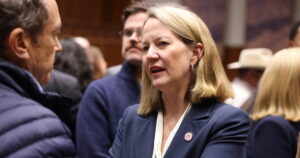
Michelle Ugenti-Rita, a former state lawmaker, has emerged as a vocal opponent of the advanced purification program in her bid for a City Council seat.
In a May campaign ad, Ugenti-Rita, alongside actor Rob Schneider, criticized her opponents by comparing a glass of clear water to a glass of brown liquid, accusing them of advocating for sewage water consumption, a claim her opponents refuted.
Following this, the council made the $100 million budgetary amendment.
Incumbent Councilman Barry Graham has labeled the program as overly expensive and an “alarmist” response to drought concerns.
Water officials from Scottsdale, Phoenix, and Tucson have also highlighted that certain new state mandates—such as the requirement to monitor unregulated chemicals—add unnecessary costs.
Randall Matas, head of the Arizona Department of Environmental Quality’s Water Quality Division, noted that while efforts are being made to simplify these new rules, they won’t be finalized until early 2027.
Despite the political tug-of-war, Cassens assured that the facility continues to operate as usual.
Ugenti-Rita was unavailable for comment, while Graham suggested that advanced purification should be a last resort during a critical water crisis.
“I can’t just assume that every visitor and resident is going to trust the experts and is even going to listen to the experts,” Graham expressed.
Half of Arizona Voters Worry About Water
The controversy in Scottsdale unfolds against a backdrop of historic lows at two vital Colorado River reservoirs—Lake Mead and Lake Powell.
A federal proposal suggests water cuts for Arizona, California, and Nevada, potentially affecting over 25 million people annually until 2036.
“It’s not really a good time to start being selective,” remarked Cynthia Campbell, former water resource management advisor for Phoenix. “Are you really going to play political games with the one thing that makes it possible to live in the desert?”
The U.S. Bureau of Reclamation has pledged more than $300 million toward advanced water purification projects in the parched West since last year.
According to AP VoteCast, which surveyed over 3,000 Arizona voters during the 2022 midterm elections, just over half expressed confidence in the state’s water supply for the next decade, while 47% were less assured.
Ben Grumbles, executive director of the Environmental Council of the States, emphasized the importance of sustained investment in public health and sustainability over short-term political gains.
“It can be frustrating when there are politicians scoring a cheap, fast point,” Grumbles stated. “I hope that over time, the facts will bear out.”