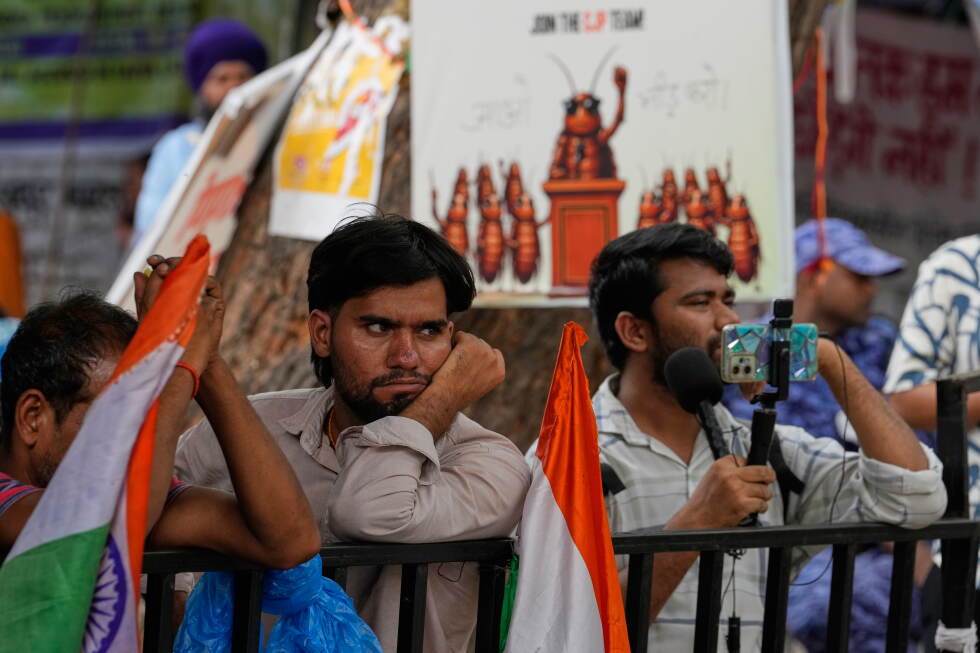
In the heart of India’s capital, a protest camp buzzes with early morning activity as student demonstrators awaken from their night under the stars. Central to this movement is Sonam Wangchuk, an activist enduring a prolonged hunger strike, symbolizing the struggle against perceived educational injustices.
“If not fasting, what? Riots in the streets? That’s what we don’t want to do. So this is a peaceful way to take your voice to the government,” Wangchuk expressed as supporters anxiously monitored his condition.
Wangchuk, at 59, has become an unexpected figurehead for the Cockroach Janta Party, a youth-driven movement that surfaced online two months ago amid allegations of leaked college entrance exams in India.
Now in its third week, the hunger strike aims to maintain pressure on Prime Minister Narendra Modi’s administration, accused by protesters of ignoring demands for the resignation of the education minister.
“There has been no kind of response from the government. They have left Sonam Wangchuk to die,” stated Abhijeet Dipke, founder of the Cockroach Janta Party and a student at Boston University.
From Social Media to Streets
What began in May as an online outcry transformed into a physical movement after Supreme Court Chief Justice Surya Kant likened some unemployed youth to “cockroaches.” The movement, embracing the derogatory term, rapidly gained traction with over 21 million Instagram followers.
The group demands the resignation of Education Minister Dharmendra Pradhan due to alleged exam leaks, alongside reforms in the examination system and compensation for families affected by student suicides.
For numerous young Indians, success in a singular entrance exam is crucial for securing government or medical college positions.
Dipke notes the transition from online support to physical presence, citing significant turnouts at universities and rallies following a major demonstration in New Delhi last June.
Wangchuk’s involvement highlights the movement’s appeal beyond educational circles, drawing support from various professionals.
Attention from high-profile figures, including opposition leaders and Bollywood celebrities, has increased, though physical turnout remains modest compared to online numbers.
At New Delhi’s Jantar Mantar, a few hundred gather daily, with numbers swelling to around 1,000 by evening. Protesters withstand monsoon rains, sleeping in tents, and unlike traditional political entities, the movement lacks formal organization, with participants funding their own travel.
IT professional Ajay Zingade, motivated by repeated exam paper leaks, joined the protest, emphasizing, “I am just exercising my fundamental right of dissent.”
Government Silence Persists
Protesters claim their movement now pushes for a broader accountability within institutions they feel have failed, including the judiciary, political system, and media.
“The system needs a complete overhaul because the current system is no longer accountable or even taking basic responsibility,” Dipke remarked.
Despite the movement’s growth, government response remains absent. The education ministry has not addressed inquiries, and senior officials dismiss the protest, with some suggesting no need for negotiation.
This government silence has only strengthened the resolve of Wangchuk and his supporters, who view his hunger strike as a peaceful call for accountability.
“In a democracy the government is supposed to listen to the people, to have a dialogue with the people, and more importantly to be answerable to the people. I don’t know why the government isn’t doing that,” stated Dipke.
Wangchuk’s peaceful disobedience aims to channel public frustration constructively, asserting, “It’s to demand accountability, which is important in any government.”
Escalating the Movement
Organizers are planning a march to Parliament to present their demands directly to lawmakers.
Wangchuk hopes this approach encourages the government to favor peaceful means of resolution, stating, “We hope that government is sensible enough to reward peaceful ways rather than wait for not-so-peaceful ways.”
Dipke affirms the movement’s commitment, declaring, “The government was thinking that maybe if they ignore us: These are kids, they will go back home. But I think we have proved that we are here for the long battle, and we are not going to go back home.”