On a solemn day at Arlington National Cemetery, history and honor intertwined as Col. Clarence E. “Bud” Anderson, the last surviving American triple ace of World War II, was laid to rest. Nearly two years after his passing at the age of 102, Anderson’s legacy was celebrated with full military honors, marking the end of an era for one of the most distinguished fighter pilots in American history.
Arlington National Cemetery Ceremony
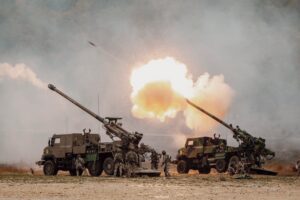
The service drew more than 100 attendees who paid their respects as Anderson was interred in Section 38, beside his wife of nearly 70 years, Eleanor “Ellie” Cosby. The ceremony featured a horse-drawn caisson, a three-volley rifle salute, and the poignant sounds of “Taps” and “Amazing Grace” played on bagpipes.
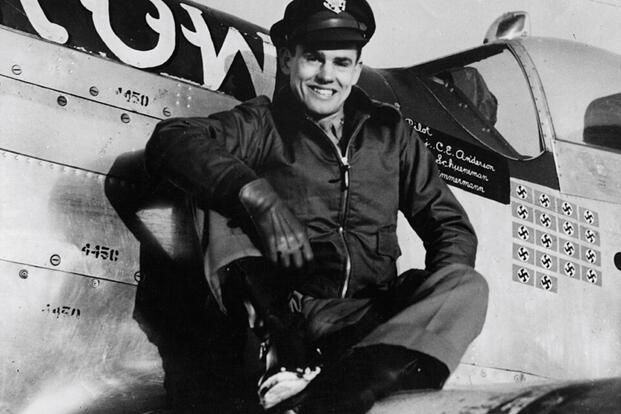
Two flyovers added a powerful tribute to Anderson’s legacy. The ceremony opened with F-35 Lightning IIs and concluded with P-51 Mustangs flying in a Missing Man Formation. Notably, two Mustangs bore the “Old Crow” nose art, a tribute to Anderson’s wartime aircraft in combat.
Jim Anderson, the colonel’s son, remarked on the unexpected F-35 flyover, saying, “That was really special.”
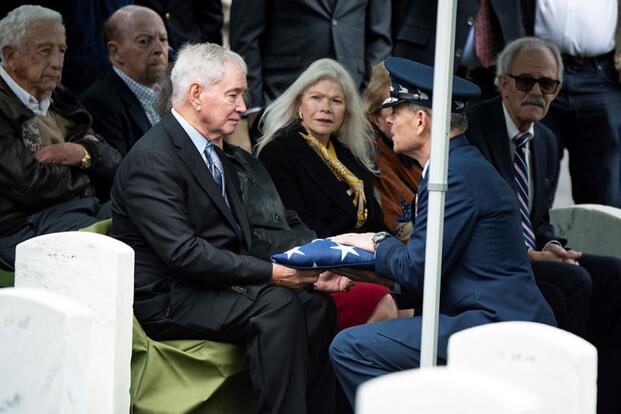
Air Force Chief of Staff Gen. Ken Wilsbach was present as the general officer host. After the Color Guard folded the American flag over Anderson’s urn, Gen. Wilsbach presented it to Jim Anderson, who shared it with his sister, Katherine “Kitty” Burlington.
“‘Bud’ Anderson is a hero and legend in air combat; he wrote the playbook,” said Wilsbach. “He mastered his craft, flew with immense courage, and leaves a legacy of service that will inspire generations.”
The Pilot of ‘Old Crow’
Born in Oakland on January 13, 1922, Anderson’s journey into aviation began early. He earned his pilot’s license by 19 and joined the Army Air Corps Aviation Cadet Program shortly after Pearl Harbor. By September 1942, he was a commissioned officer in the U.S. Army Air Forces.
Assigned to the 363rd Fighter Squadron of the 357th Fighter Group, Anderson flew 116 missions, achieving the rare status of triple ace with 16.25 aerial victories. His aircraft, all named “Old Crow,” completed both tours without sustaining enemy fire or mission aborts.
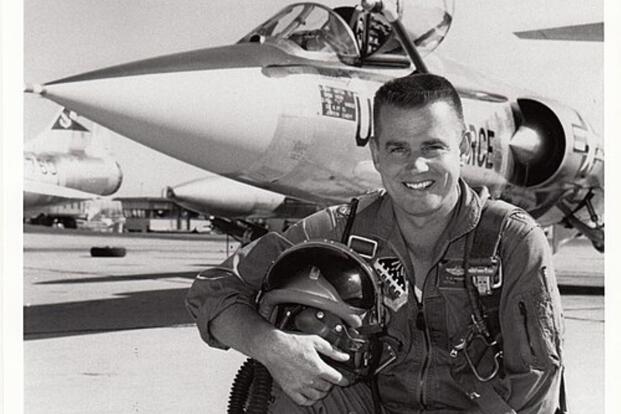
Anderson’s career continued post-war as a test pilot during the jet age and included command roles in the Korean and Vietnam wars. Retiring in 1972 as a colonel, he had flown over 130 different aircraft models for more than 7,500 hours.
Throughout his career, Anderson earned numerous accolades, including five Distinguished Flying Crosses, two Legions of Merit, and recognition from France. He continued to contribute to aviation with McDonnell Douglas and co-authored his memoir, “To Fly and Fight,” in 1990.
A Vanishing Generation
While the 22-month delay between Anderson’s death and burial might seem prolonged, it’s not uncommon. Arlington’s scheduling can extend due to high demand and limited personnel, especially for cremated remains.
Jim Anderson, who followed in his father’s footsteps with a career in aviation, shared his experiences of trying to keep his father’s identity a secret to establish his own career, although it often came to light.
“When I was in the Air Force, I tried to keep it a secret who my father was because I wanted to make [my career] my own,” he said. “But eventually people would find out.”
Anderson’s burial follows the passing of Don McPherson, the last known living WWII ace, underscoring the fading presence of a generation of pilots. With advancements in aerial technology, the legacy of these fighter aces becomes a poignant chapter in military history.