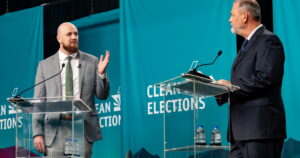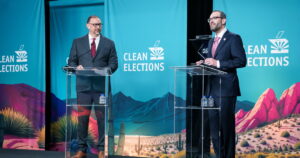
In a pivotal legal battle over the management of elections in Maricopa County, a decision by the Arizona Court of Appeals has altered the course of a yearlong dispute. This development has led to the cancellation of mediation efforts between the Maricopa County Board of Supervisors and Recorder Justin Heap.
The appellate court recently stayed a previous ruling that favored Heap, which was set to restore certain election management duties to his office. This stay also postpones the immediate transfer of control over specific information technology resources from the board to Heap, a move that would have required the separation of jointly managed election systems.
No More Mediation
With the appellate court’s intervention, the lower court has relinquished its jurisdiction over the case. Consequently, Maricopa County Superior Court Judge Scott Blaney canceled a scheduled hearing on Heap’s motion to hold the board in contempt, as well as an order for both parties to convene with Judge Christopher Coury to negotiate a resolution.
Despite Judge Blaney’s indication that a voluntary settlement conference could still occur, the parties have not reached an agreement to proceed.
Heap has attributed the breakdown in negotiations to the board, claiming they withdrew from mediation after the appellate court’s stay. “The facts speak for themselves,” Heap stated, emphasizing that the board initially agreed to mediation but later opted out before discussions could commence.
Conversely, the board insists that Heap is obstructing progress, citing his refusal to finalize a new shared services agreement that outlines the collaborative electoral responsibilities between the board and recorder in Arizona’s dual-administration system.
Board Chair Kate Brophy McGee and Vice Chair Debbie Lesko extended an invitation for further discussions post-stay, albeit without a mediator. Brophy McGee remarked, “There currently is no mediation order in effect, as it was vacated by the lower court following the appellate court’s issuance of an emergency stay.”
The board has referenced past communications to illustrate efforts towards consensus, including a text message from Heap in April 2025 and a subsequent email from Heap’s Chief of Staff Sam Stone, both indicating agreement on several disputed issues. However, Heap later retracted Stone’s email, deeming it erroneous.
Heap’s attorney, James Rogers, who represents him despite opposition from Maricopa County Attorney Rachel Mitchell, maintains that mediation is necessary to avoid the board’s alleged “grandstanding” during previous meetings.
What’s Next?
The appellate court’s decision was heavily influenced by the Purcell Principle, a Supreme Court guideline discouraging major changes just before elections. Heap’s attorney has challenged this ruling, appealing to the Arizona Supreme Court on the grounds that the case does not impact voter procedures but rather involves the internal administration of election functions.
“Nor does this case implicate the concerns that gave rise to Purcell,” Rogers argued in his Supreme Court filing. “It concerns which county office has final authority over internal election-administration functions and the resources needed to perform them.”