A Journey to the Past: Cadets Explore Holocaust History to Shape Future Leadership
For many, understanding the Holocaust is limited to textbooks and documentaries. For Jacob Gelder, an Air Force Academy cadet, this understanding took a profound turn during a recent visit to Auschwitz, a site that transformed his perception of history’s darkest chapter. Gelder’s experience was part of a broader initiative aiming to instill ethical leadership in future military leaders.
Gelder, along with five fellow cadets, joined a group of 25 U.S. service academy cadets and midshipmen on a visit to Poland as part of the Auschwitz Jewish Center Foundation’s American Service Academy Program (ASAP). Celebrating its 20th anniversary, the program is dedicated to teaching future military leaders by reflecting on the Holocaust’s moral lessons.
Jack Simony, director-general of the Auschwitz Jewish Center Foundation, emphasized the program’s goal: “We view the midshipmen and cadets to be the best and brightest America has to offer, and they are our future leaders.” He added, “Our mission is education, and ways in which to effectuate a better world and combat hate.”
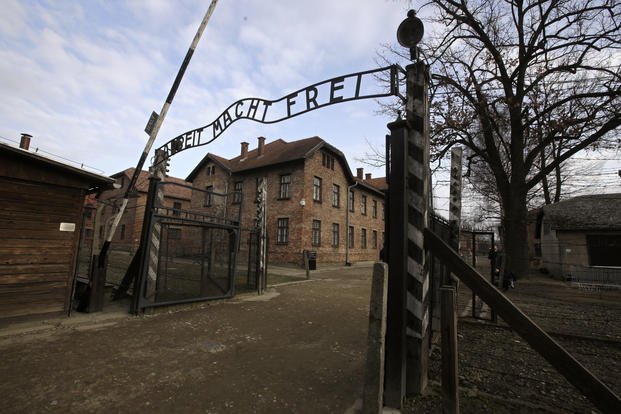
The cadets embarked on a 16-day journey starting in Poland, where they delved into the history of the prewar Jewish community. They explored the remnants of the Krakow ghetto, walked through Auschwitz I and Auschwitz-Birkenau, and contributed to the upkeep of the Oswiecim Jewish cemetery.
Curtis Jett, another participant who will soon start his junior year at the Air Force Academy, described the experience as “eye-opening.” Reflecting on the grim history, he said, “We saw where the prisoners were housed. We saw the belongings that were taken from them, the hair that was shaved from them. We saw the posts where they were hanged. I thought, ‘How could anybody stand by and watch this happen?’”
Simony pointed out the gradual progression of antisemitic rhetoric and policies, noting that Auschwitz was the culmination of this “path to hate.” He explained, “When you look at Auschwitz and the other concentration camps, it’s beyond comprehension. But you have to understand that Auschwitz is the end of the road of hate, not the beginning.”
In the second phase of the program, the participants traveled to New York City. There, they explored the Museum of Jewish Heritage, engaged with Holocaust survivors, and visited the 9/11 Memorial. Simony highlighted the importance of these experiences, saying, “By going over the decisions that were made 80 years ago, that led to the greatest mass atrocity in the world, you hope to use those lessons to identify, early, when you’re going in the wrong direction.”
Despite the grave nature of the Holocaust’s history, Jett and Gelder found moments of hope. Jett mentioned visiting Oskar Schindler’s factory, where Schindler saved over 1,000 Jewish lives, and learning about Denmark’s efforts to rescue Jewish people. “Even when the worst evil is occurring, there are people who will stand up and do the right thing, even at risk to themselves,” Jett remarked.
For Gelder, the program reinforced the importance of speaking out against injustice. “It’s important to step up and say something when you see things that are not right,” he said. “That’s what I will take away from the program.”
Simony expressed admiration for the cadets and midshipmen involved in the program. “They are outstanding individuals,” he noted. “They care about creating a better world and are seeking the best ways to do that.”
© 2025 The Gazette (Colorado Springs, Colo.). Visit www.gazette.com. Distributed by Tribune Content Agency, LLC.
© Copyright 2025 The Gazette (Colorado Springs, Colo.). All rights reserved. This material may not be published, broadcast, rewritten or redistributed.