The Korean War, which erupted in 1950, thrust the United States into a new realm of aerial warfare, one characterized by the rapid pace and technological prowess of jet combat. Pilots, who had been trained for the propeller-driven dogfights of World War II, suddenly found themselves confronting a high-stakes aerial battlefield over “MiG Alley,” a narrow corridor of airspace above the Yalu River, which became a crucible for the U.S. Air Force in mastering jet combat.
The conflict saw the first large-scale engagements between jet fighters, specifically the American F-86 Sabres and Soviet-designed MiG-15s, marking a pivotal chapter in military aviation history. The strategies and insights gained during these duels continue to influence U.S. pilot training, from fundamental maneuvers to advanced tactics taught at Nellis Air Force Base.
Energy, Not Agility
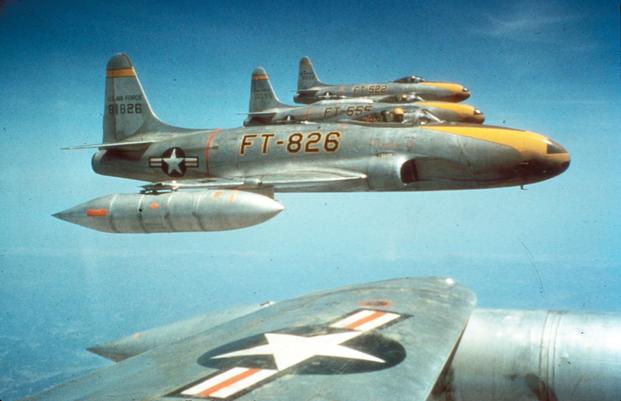
The introduction of Soviet-built MiG-15s over North Korea in late 1950 presented a significant challenge to the straight-wing American F-80 Shooting Stars and F-84 Thunderjets. The MiG’s swept wings allowed superior climbing speed and altitude, maintaining momentum in combat. In response, the U.S. deployed the North American F-86 Sabre, which, while slower in ascent, excelled in high-speed dives, ideal for the rapid, aggressive tactics over MiG Alley.
The Sabre’s true innovation lay in its radar gunsight, the AN/APG-30 system, which calculated distances automatically, allowing pilots to focus on strategic positioning rather than manual range estimation. Sabre pilots capitalized on their aircraft’s strengths by maintaining altitude superiority, executing swift, high-speed strikes, and ascending before the enemy could retaliate.
Capt. James Jabara, the world’s first jet-versus-jet ace, epitomized this approach, tallying 15 confirmed MiG kills over two tours in Korea. The tactics honed in MiG Alley formed the bedrock of the “energy-maneuverability” theories later developed by Air Force tactician Col. John Boyd, principles that remain central to air combat training today.
Awareness Wins the Fight
With closing speeds nearing 1,000 miles per hour, situational awareness was crucial in Korean War air battles. The U.S. Air Force developed an early radar and ground-control network to direct Sabre units toward enemy formations, marking one of the first uses of radar-assisted air control in conflict. This system laid the groundwork for today’s Airborne Warning and Control System (AWACS).
Pilots quickly realized that survival depended on discipline and teamwork rather than individual heroics. As Joseph C. McConnell, the top American ace of the war, stated, “It’s the teamwork out here that counts. The lone wolf stuff is out. Your life always depends on your wingman, and his life on you. I may get credit for a MiG, but it’s the team that does it, not myself alone.”
This shift from solo acts to coordinated efforts led to the adoption of paired and four-ship formations, emphasizing constant scanning, effective communication, and adherence to formation roles. These practices are still integral to U.S. pilot training, from the T-38s in flight school to the operational F-35s.

Training Matters More Than Technology
According to the Air Force’s official records, F-86 pilots achieved 792 MiG kills for 78 combat losses, translating to a 10-to-1 ratio. Subsequent reviews, like the Sabre Measure Charlie, adjusted this to about 5-to-1, reinforcing the idea that superior training was the decisive factor in combat effectiveness.
While many MiG-15s were piloted by experienced Soviet veterans, their operations were restricted by stringent rules, unlike their American counterparts who benefited from more frequent flying, extended training, and tactical flexibility. Their mastery of radar, teamwork, and gunnery accentuated the Sabre’s advantages.
Post-war, the U.S. Air Force revamped its fighter training programs, evolving the Gunnery School at Nellis Air Force Base into the Fighter Weapons School. This overhaul was informed by Korean War after-action reports, emphasizing energy management, intercept geometry, and coordinated attacks.
Legacy of MiG Alley
The Korean War concluded without a definitive air superiority victory, yet it imparted crucial lessons. Pilots realized the importance of altitude, energy, and situational awareness over mere technological advances. These insights, complemented by radar intercept networks developed over the Yalu, laid the foundation for modern command-and-control systems.
At Nellis Air Force Base, the Air Force Weapons School continues to examine the engagements spearheaded by pilots like Jabara and McConnell. Their reports, crafted in the harsh conditions of Korea, are integral to the curriculum for today’s pilots operating advanced aircraft.
While contemporary fighters are faster and equipped with advanced missile systems, the core principles of aerial combat—honed over Korea—remain unchanged, underscoring the enduring legacy of those early jet battles.