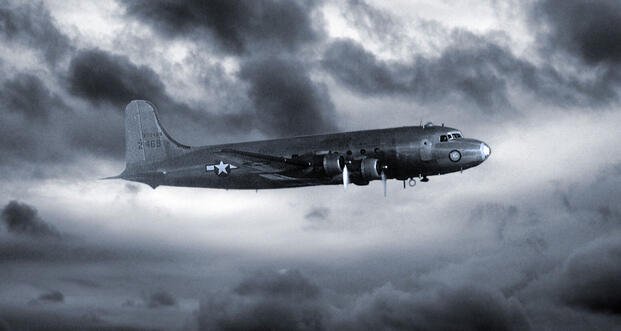
In a remarkable turn of events, a collaborative effort is underway to locate a U.S. Air Force transport plane that disappeared over the Yukon 75 years ago. Using cutting-edge technology that was unimaginable at the time of the crash, a dedicated team of volunteers and experts is determined to uncover the fate of the Douglas C-54 Skymaster and the 44 individuals on board.
The 1950 Disappearance
On January 26, 1950, the Douglas C-54 Skymaster took off from Elmendorf Air Force Base with 42 service members and Joyce Espe, a pregnant military wife, and her young son. Despite initial reports of ice forming on the wings during the flight, no further contact was made, and the aircraft vanished without a trace.
The Air Force conducted an extensive search but ultimately abandoned efforts to locate the plane. Today, a new mission employing artificial intelligence and satellite technology seeks to solve this decades-old mystery.
Revisiting the Past
Clare Fowler, a radio operator in Snag, Yukon, was the last to hear from the Skymaster, which reported icing conditions before disappearing. The plane’s suspected ice-related crash likely buried it under a glacier, rendering it inaccessible for decades.
Michael Luers, familiar with the perilous conditions of icy flights, is spearheading the current search. “I have personally experienced a plane icing over—giant drops of water freezing on the plane, hundreds at a time,” he recalled.
The Search Efforts and Challenges
The absence of a federal agency to handle non-combat military accidents has left families in limbo. Despite the initial large-scale search, including Operation Mike, efforts were redirected after a B-36 bomber incident, leaving the Skymaster lost in memory.
Project Recover and the Civil Air Search and Rescue Association are now leading the renewed search using advanced technology. The team includes experts like Jim Thoreson and Nelson Mattie, who bring years of experience and remote sensing expertise to the mission.
Family Stories and Unyielding Hope
The crash deeply affected many families, including that of Master Sergeant Robert Espe, who lost his wife and son. His pursuit to find his family has inspired this new search effort, supported by his daughter Kathy and her former husband Luers.
Larry Floyd, a relative of another victim, Sgt. Junior Lee Moore, expressed hope that the new search would bring closure. “I’m extremely grateful they’re doing this,” he said.
Technological Innovation in Search Operations
The team’s strategy involves analyzing synthetic aperture radar, multispectral satellite imagery, and LiDAR data with AI designed to detect aircraft wreckage. “First thing we have to recognize is this is a huge search area,” Luers said, emphasizing the importance of this technology.
Phase One uses SAR data and multispectral imagery to scan the 4,500 square-mile area. If promising leads are identified, they will be verified via helicopter in collaboration with local authorities. Phase Two could involve high-density LiDAR mapping if needed.
Funding and Future Prospects
Funding is critical for the mission, with Phase One costs estimated at $160,000. Vantor has offered discounted imagery services, and donations can be made through Project Recover’s website.
“Without funding, the mission is not possible,” Luers emphasized, highlighting the importance of community support to bring the missing servicemembers home.