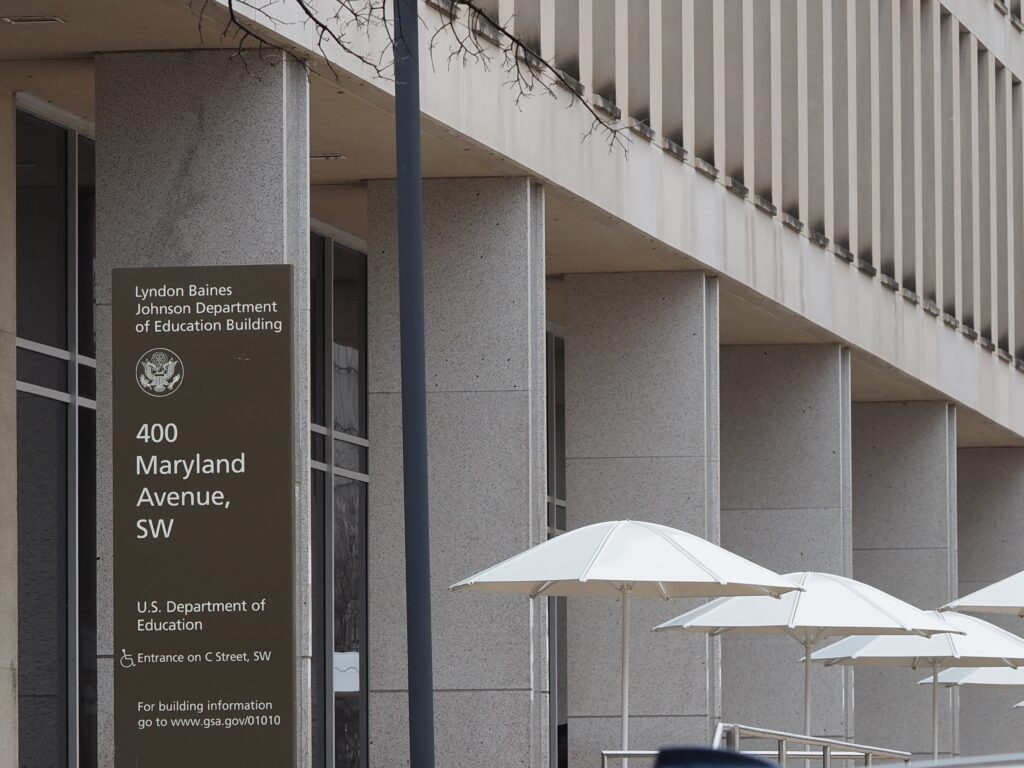

The U.S. Department of Education on Feb. 20, 2026. (Photo by Shauneen Miranda/States Newsroom)
The Trump administration has announced a pivotal shift in federal student loan management, with the U.S. Treasury Department assuming the task of collecting defaulted student loans from the Department of Education. This transition marks the beginning of a broader strategy to eventually transfer the entire student loan portfolio to Treasury, as part of an ongoing effort to decentralize the federal role in education.
According to a senior official from the Department of Education, the collaboration with the Treasury Department leverages their “longstanding partnership” in federal student aid programs. The Education Department, which currently oversees approximately $1.7 trillion in student loans, reports that less than 40% of borrowers are actively repaying their loans, with nearly a quarter of them in default.
The initial phase of this transition will see Treasury offering operational support to aid the Education Department in resuming loan repayments. As the process unfolds, Treasury will expand its operational support to include non-defaulted federal student loans, wherever feasible and legally permissible. The official assures that borrowers will experience “better customer service” without any immediate changes to their current payment routines.
Department forges multiple agreements
Education Secretary Linda McMahon emphasized the significance of utilizing Treasury’s financial and economic expertise, stating, “by leveraging Treasury’s world-renowned expertise in finance and economic policy, we are confident that American students, borrowers, and taxpayers will finally have functioning programs after decades of mismanagement.” The Education Department has also initiated nine other agreements with various federal departments, transferring several responsibilities as part of a proposed departmental wind-down.
In July 2025, the U.S. Supreme Court provisionally approved plans for substantial layoffs and a significant downsizing of the Education Department, initially directed by a March 2025 executive order. This directive instructed McMahon to “take all necessary steps to facilitate the closure” of the department she leads.
‘Irresponsible, reckless’
Opposition to these moves is vocal. Sen. Patty Murray of Washington criticized the administration’s focus on dismantling the department, stating, “instead of helping student borrowers get the support they need, Secretary McMahon is focused on illegally hollowing out the department she leads and creating new, harmful bureaucracy while she’s at it.” Murray described the agreements as unnecessary bureaucracy that threaten essential student services.
Rachel Gittleman, president of the American Federation of Government Employees Local 252, which represents Education Department employees, also condemned the announcement. She called it “an insult to the nearly 43 million Americans with federal student loan debt and to the taxpayers who depend on federal oversight to prevent waste, fraud and abuse.” Gittleman pointed out that since McMahon’s leadership began, significant workforce reductions have occurred, impacting oversight of the $1.7 trillion loan portfolio.
The reduction in staff has been highlighted by a Government Accountability Office (GAO) report, which notes that these cuts have hindered the government’s ability to effectively evaluate loan servicers’ performance. Aissa Canchola Bañez of Protect Borrowers labeled the administration’s decision as “irresponsible, reckless, and bad news for our most vulnerable student loan borrowers,” warning that it could exacerbate financial hardships amid a growing affordability crisis.