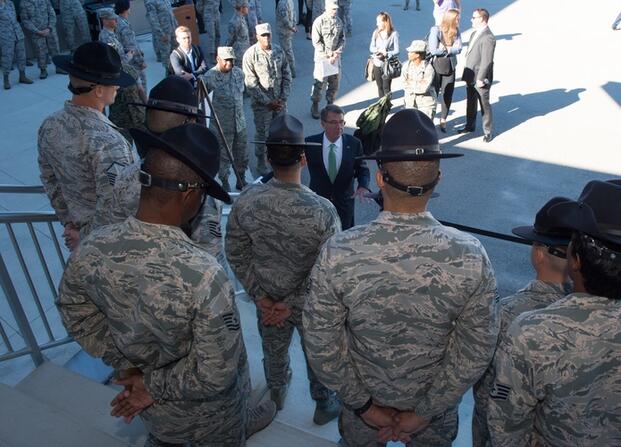
In a notable case unfolding at Joint Base San Antonio-Lackland, Staff Sgt. Davonte Hardaway, a military training instructor, is facing serious allegations. Accusations against him involve engaging in prohibited sexual relationships with trainees, potentially impacting the integrity of Air Force basic military training.
The charges indicate that Hardaway, who is part of the 324th Training Squadron, allegedly had inappropriate relationships with three female recruits during 2024 and 2025. These actions, if proven, could violate the Uniform Code of Military Justice, as they relate to unprofessional relationships and misuse of authority as an instructor. The trial is scheduled to commence on June 8, 2026, and a conviction could lead to significant penalties, including confinement and a bad-conduct discharge.
Allegations and Legal Framework
The allegations suggest a breach of strict regulations in the training environment. Staff Sgt. Hardaway is accused of forming sexual relationships with three trainees, contrary to military conduct standards. The charges involve Article 92 for disobeying lawful orders and Article 93a for prohibited activities with recruits under the Uniform Code of Military Justice.
Both articles aim to enforce clear boundaries in training settings, where the power disparities between instructors and trainees could render consent legally invalid. Additionally, prosecutors might invoke Article 134 to address broader issues of discipline and the potential tarnishing of the armed forces’ reputation.
The Training Environment’s Unique Challenges
The significance of this case is amplified by the nature of basic military training at Lackland, where trainees are under stringent control and supervision. The 37th Training Wing, the largest in the Air Force, processes over 36,000 recruits annually, emphasizing the need for professional conduct from instructors.
Breaches of the professional boundaries by instructors can raise serious concerns about oversight and the overall integrity of the training system, affecting not just individual cases but the entire training pipeline.
Historical Context and Ongoing Concerns
This case revives memories of a large-scale scandal at Lackland over a decade ago, where numerous instructors faced scrutiny for misconduct. The Air Force’s response then included reforms like enhanced supervision and ethics training, aiming to prevent recurrence.
Although the current case does not imply systemic failure, it highlights persistent risk factors, especially the power imbalance between instructors and trainees.
Proceedings and Accountability
Currently, Hardaway is not fulfilling his duties as an instructor while the case is pending. The Air Force has maintained confidentiality regarding investigation details, a standard practice in court-martial processes.
The choice of a special court-martial reflects the seriousness of the alleged misconduct, with defined sentencing limits compared to a general court-martial. As the legal proceedings unfold, the Air Force emphasizes the importance of maintaining professional integrity in its training operations.