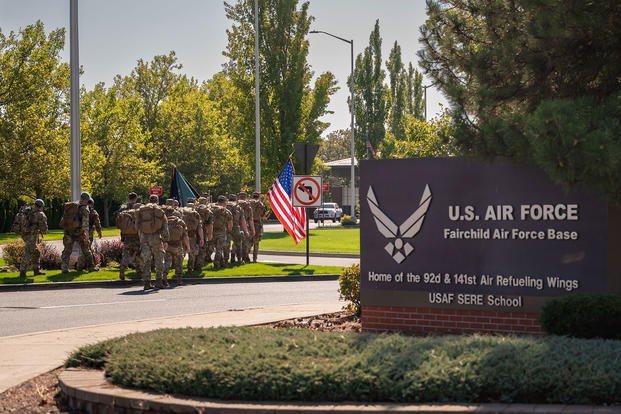
Delay in Fairchild Air Force Base Chemical Cleanup
A new directive from the Department of Defense could extend the timeline for addressing chemical contamination at Fairchild Air Force Base until 2032. This development is part of a broader strategy affecting nearly 140 military locations across the United States, as initially reported by the New York Times.
Perfluoroalkyl and polyfluoroalkyl substances, commonly referred to as “forever chemicals,” have been utilized in numerous products over the years, including firefighting foams on military sites. These substances are linked to various health issues, such as cancers and heart disease.
High concentrations of these chemicals have been detected in the West Plains area, likely originating from Fairchild Air Force Base and Spokane International Airport, both of which have used firefighting foams containing PFAS. Contamination of groundwater in these regions has been a significant concern since 2017.
Efforts to address the contamination at Fairchild began with a preliminary assessment, followed by an ongoing investigation into the PFAS impact. This investigation is nearing completion, after which a feasibility study will explore potential cleanup methods. Originally, these steps were to conclude by July 2026, but the new timeline extends this to June 2032, delaying the actual cleanup even further.
John Hancock, a resident of West Plains and president of the West Plains Water Coalition, expressed frustration over the delay. “It feels like the Air Force would really choose not to do anything rather than make some moves towards the additional safety of their neighbors,” he remarked, highlighting that “no significant action” has been taken by the base.
Hancock, who is involved in the Fairchild Restoration Advisory Board, noted that the recent remedial investigation presented by the Air Force did not offer a concrete plan for cleanup. “The remedial investigation is not a plan, it’s just an investigation,” he said, noting that a plan would only be developed post-investigation.
In the interim, the Air Force has supplied 109 water filters to homes in the vicinity, which are expected to be effective for five more years. As of now, no comments have been received from Air Force officials.
Parallel to these efforts, Spokane International Airport is also undergoing a remedial investigation and feasibility study under the guidance of the Washington Department of Ecology. The airport’s operations are managed by a board under the jurisdiction of Spokane city and county governments. Both entities have been deemed accountable for the PFAS cleanup by the Department of Ecology.
Erin Hut, a city spokesperson, confirmed that the city would collaborate with the airport and the county to tackle the issues outlined by Ecology. “Spokane International Airport, under the direction of the Spokane Airport Board, is the sole operator of the airport and has the lead with respect to direction provided by the state of Washington related to the PFAS investigation and response,” she stated.
© 2025 The Spokesman-Review (Spokane, Wash.). Visit www.spokesman.com. Distributed by Tribune Content Agency, LLC.
© Copyright 2025 The Spokesman-Review. All rights reserved. This material may not be published, broadcast, rewritten or redistributed.