In a recent incident, a U.S. military refueling aircraft, the KC-135, tragically crashed in western Iraq, a development that underscores the ongoing risks faced by military operations abroad. This crash, which resulted in the loss of four crew members, highlights the challenges and dangers of aerial refueling missions.
The U.S. Central Command announced the unfortunate event, noting that it involved two aircraft in what was described as “friendly airspace.” While the second plane managed to land safely, the KC-135 did not, marking the fourth such crash during current operations against Iran.
The KC-135: A Stalwart of Midair Refueling
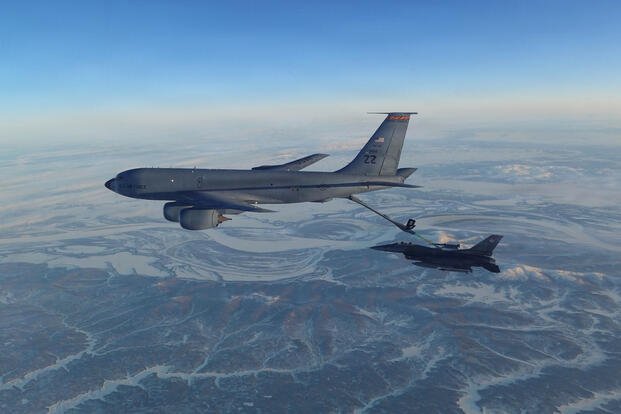
The KC-135 Stratotanker, a key asset of the U.S. Air Force, primarily functions to refuel aircraft mid-flight, thus extending their operational range and endurance. It also serves as a critical support vehicle, capable of medical evacuations and surveillance.
Derived from the Boeing 707 design, the KC-135 has been operational for over six decades, assisting not only the U.S. military but also allied forces. As these tankers gradually make way for the newer KC-46A Pegasus, concerns about their longevity and reliability persist due to their age.
Security expert Yang Uk from South Korea’s Asan Institute for Policy Studies commented, “The last of these planes were produced in the 1960s,” emphasizing the need for the KC-46A transition, which has experienced delays. The Air Force currently maintains 376 KC-135s, spread across active duty, the Air National Guard, and the Air Force Reserve.
A standard KC-135 requires a crew of three: a pilot, co-pilot, and a boom operator. However, for medical missions, additional personnel are on board. The refueling process, managed by the boom operator at the aircraft’s rear, involves connecting a fuel boom to receiving aircraft, a task sometimes performed while the operator is lying prone.
Investigation Underway Following Tragic Crash
The crash resulted in the death of four out of the six crew members on board. U.S. Central Command confirmed these figures and indicated that rescue operations are ongoing. It was also clarified that the crash was not a result of hostile or friendly fire.
Further details revealed that the other involved aircraft was another KC-135, which safely landed in Israel, as confirmed by Yechiel Leiter, the Israeli ambassador to the U.S. Military analyst Yang Uk pointed out the rarity of refueling tankers being targeted by enemy fire due to their operational positioning.
This incident follows the accidental downing of three U.S. F-15E fighter jets by friendly Kuwaiti fire, illustrating the complexities and dangers of military engagements.
A History of Accidents
Historically, the KC-135 has been involved in several accidents. A notable incident occurred in 2013 when a KC-135R crashed in Kyrgyzstan due to rudder issues, leading to an in-flight breakup and the loss of all crew members.
An earlier, more catastrophic event in 1966 saw a B-52 bomber collide with a KC-135 over Spain, resulting in a crash that necessitated a massive cleanup effort due to the dispersal of nuclear materials.
___
Schreck reported from Bangkok. AP writers Ben Finley and Konstantin Toropin in Washington contributed.
© Copyright 2026 Associated Press. All rights reserved. This material may not be published, broadcast, rewritten or redistributed.