The ripple effects of the longest U.S. government shutdown are being felt not only at home but also across the Atlantic. Thousands of local workers at U.S. military bases in Europe are now facing financial uncertainty as their salaries have been disrupted.
Since the shutdown began nearly six weeks ago, over 2,000 employees stationed at U.S. military facilities in Europe have experienced interruptions in their pay. Some host countries have temporarily shouldered the financial burden, assuming the U.S. will eventually cover these costs. In contrast, employees in Italy and Portugal continue to work without pay as the impasse in Washington persists.
Angelo Zaccaria, a union coordinator at Aviano Air Base in northeastern Italy, expressed his frustration, stating, “It’s an absurd situation because nobody has responses, nobody feels responsible.” He emphasized the severe impact this situation is having on Italian employees.
Crucial Roles and Payment Agreements
Local nationals fulfill essential roles at U.S. bases worldwide, covering areas like food service, construction, logistics, and specialized tasks. They might be directly hired by the U.S. government or through private companies. Payment agreements for these employees differ by country, as noted by Amber Kelly-Herard, spokesperson for the U.S. Air Forces in Europe and Africa, who insisted that local employees must continue working per their contracts during the shutdown.
The Pentagon provided a brief statement acknowledging the importance of local employees but declined to address specific queries about the pay disruption.
Host Nations Step In
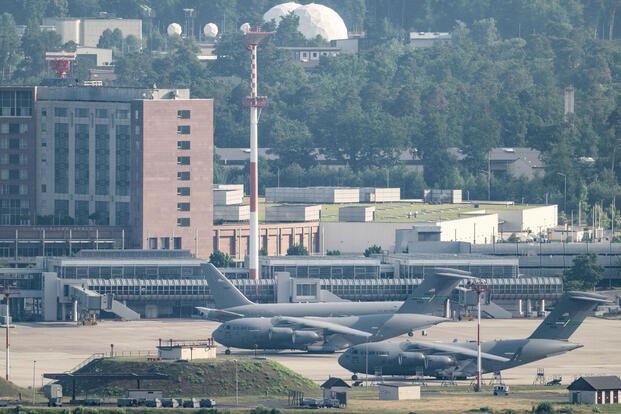
In Germany, the government is covering salaries for nearly 11,000 civilian workers on U.S. military bases, including the strategically significant Ramstein Air Base. Meanwhile, other nations have not been as fortunate.
In Italy, more than 900 local employees at Aviano and Vicenza bases, along with 400 at a Livorno base, remain unpaid. Zaccaria, representing these workers, has urged the Italian government to intervene, highlighting the struggles faced by employees who are having difficulty meeting basic financial obligations.
Similarly, in Portugal, over 360 workers at the Lajes Field base in the Azores have not received their wages. Paula Terra, from the Lajes workers’ committee, noted that workers continue to report for duty since furloughs aren’t recognized under the U.S.-Portugal base agreement. Recently, the Azores regional government approved a bank loan to temporarily alleviate this issue.
Germany anticipates reimbursement once the shutdown concludes, as past shutdowns saw the U.S. covering such costs. However, Poland, Lithuania, and Greenland did not provide comments on their positions regarding the payment of local workers.
Contractors at Risk
According to Linda Bilmes, a Harvard Kennedy School public policy professor, contractors at U.S. military bases are most vulnerable during shutdowns. While full-time employees historically receive back pay, contractors might not, leading some to incorporate additional fees into contracts for protection against funding halts.
In Spain, where the U.S. operates bases in Moron and Rota, a union representing Spanish workers reported that payment delays were resolved last month with support from the Spanish government, although the defense ministry did not confirm their involvement.
___
Contributions to this report were made by Konstantin Toropin in Washington; Barry Hatton and Helena Alves in Lisbon, Portugal; Giada Zampano in Rome; and Stefanie Dazio in Berlin.
© Copyright 2025 Associated Press. All rights reserved. This material may not be published, broadcast, rewritten or redistributed.