Every year, sailors face one of the most dangerous and least visible emergencies at sea: falling overboard with no one watching. The U.S. Navy is now testing technology that could change that — but the road from a promising demonstration to fleet-wide protection is longer than a single successful test.
Engineers at the Naval Surface Warfare Center, Port Hueneme Division, have been developing the Man Overboard Detection System, a platform that uses thermal cameras and video analytics to identify when someone enters the water and immediately alert the crew. The project is led by Eric King, a former petty officer first class who understands the stakes from personal experience.
King told Task and Purpose:
“Being a former sailor myself, that was always something that was in the back of my mind: ‘Wow, if I fall overboard in the middle of [the] night, hopefully someone sees me. There’s nothing that will instantly detect if someone falls from the ship. I think the system closes that gap and provides peace of mind, and not just for the sailors, but for the fleet.”
Why Timing Is Everything
On large naval vessels carrying hundreds or thousands of personnel, it is physically impossible for any crew to watch every stretch of railing at all times. When someone goes overboard unnoticed, precious minutes can pass before anyone realizes what happened — and those minutes can determine whether a rescue succeeds or fails.
Mario Vittone, a maritime safety expert and former Coast Guard rescue swimmer, described how dramatically the outcome can shift based on how quickly an alert goes out. He told Military Times:
“The significance between ‘I know exactly where you fell off’ and ‘I sort of know it was in the last few minutes’ can be staggering.”
Vittone was direct about what a delayed response means for survival odds.
“If the vessel you are on loses sight of you and they have to do a search or call in another asset such as the USCG, another military helicopter, etc., then you have slipped into the more likely to die than live category,”
he said.
An immediate, automated alert preserves the two most critical pieces of rescue information: the moment a person entered the water and the exact location where it happened.
“Knowing that they went in is number one,”
Vittone said.
“Exactly where they went in matters a great deal.”
Once a ship moves past someone in the water, wind and current can pull that person away from their last known position while waves and sea foam can hide them from view.
Vittone summed up the core value of automation this way:
“The real value of these systems is removing the human limitations of manpower and fatigue.”
David Dozal, a systems engineer at the Naval Surface Warfare Center Port Hueneme Division, echoed that point, telling Military Times:
“A human lookout can easily miss an incident in the dark or due to distraction, whereas the man overboard camera system provides continuous monitoring.”
Dozal added that the thermal imaging technology performs as well as or better than a human observer during daytime conditions, with an even greater advantage at night or in low visibility.
The Technical Challenge of Telling People from Debris
Detecting any movement at sea is relatively straightforward. Detecting a specific human being — reliably, without constant false alarms — is far harder. Waves, sea spray, birds, floating trash and shifting light conditions all create visual noise that an automated system must learn to filter out.
Vittone framed the problem plainly:
“Is that a body or a bag of trash? Is that a body or sea birds swooping by the hull?”
He believes the most effective systems will combine artificial intelligence with multiple types of sensor data, potentially including visual imaging, thermal detection, and LiDAR — Light Detection and Ranging technology.
A 2024 review published in the Journal of Marine Science and Engineering analyzed 51 research papers on automated detection and tracking in maritime person-overboard scenarios. The review highlighted how much a person’s position and physical condition in the water affect how easily a system can identify them, noting that a detection platform must do more than recognize an upright, clearly visible person on a calm surface.
False alarms carry their own risk. A system that repeatedly flags debris or seabirds as emergencies could erode crew confidence to the point where real alerts get ignored. A system that fails to detect someone in rough water or darkness creates the opposite problem: the false sense of safety with no reliable performance behind it.
How the Navy Tested the Technology
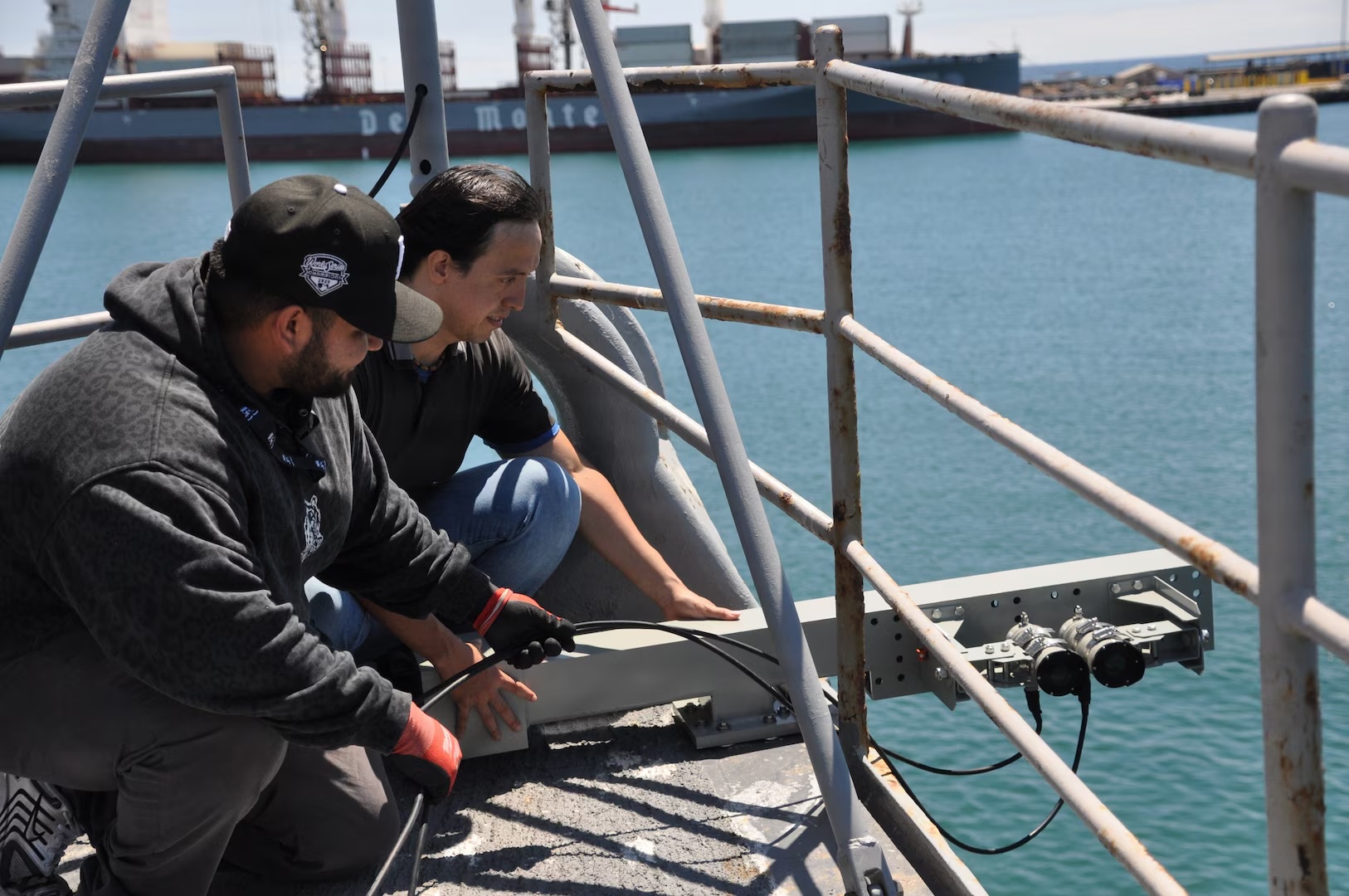
The Navy conducted its first demonstration on August 14 aboard the Navy’s Self Defense Test Ship, the ex-Paul F. Foster, a decommissioned destroyer now used as a testing platform. Engineers installed four thermal cameras across two fabricated pedestals positioned approximately 200 feet apart along the ship’s starboard side. Each pedestal held two cameras — one focused on the area immediately alongside the hull and another covering medium to longer ranges — with overlapping fields of view designed to minimize blind spots.
To simulate a person falling overboard, the team used a 6-foot, 35-pound vinyl rescue dummy named OSCAR — a reference to the international signal flag for a man-overboard emergency. Mechatronics engineer Daniel Lopez and systems engineer David Dozal repeatedly dropped the dummy over the side while the rest of the team monitored footage from inside the ship.
The Navy described the demonstration as a success in proving that the cameras and software could detect a simulated overboard event. However, the test had notable limitations: the bridge alarm that would notify watchstanders in a real emergency was not part of the demonstration, and the cameras covered only a portion of the ship rather than the full perimeter that an operational system would need to monitor.
The project was initially funded through the Naval Innovative Science and Engineering program, which supports research and development at Navy warfare centers. That funding has since ended, and the development team is now searching for a new source of money to advance the work. Their next goal is to test the system aboard an operational guided-missile destroyer in San Diego — a significantly more demanding environment than the August demonstration. A permanent installation would require cameras to be physically secured to a working ship’s deck, cables routed safely throughout the vessel, and the system integrated with existing crew notification infrastructure. Developers would also need to establish full installation costs and ongoing maintenance requirements.
Whether the Navy can move this technology from a controlled proof of concept to a dependable, fleet-wide safety tool will ultimately depend on securing continued funding, completing testing under real operational conditions, and determining whether the system can be practically installed and maintained across the fleet.