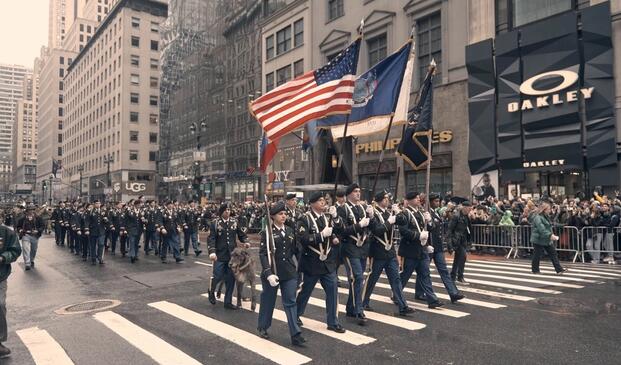
The streets of New York City will be alive with vibrant festivities as the 265th annual Saint Patrick’s Day Parade takes place. This year, the historic celebration will be led by the New York Army National Guard’s 1st Battalion, 69th Infantry Regiment, famously known as “The Fighting 69th.”
“New York City’s Fighting 69th’ is always honored to lead the New York City St. Patrick’s Day Parade,” expressed Lt. Col. Andrew Prior, the battalion’s commander, in a statement obtained by Military.com. “This year carries special meaning as our battalion marks its 175th time leading the parade.”
Celebrated as the oldest and largest of its kind globally, the New York City St. Patrick’s Day Parade first took place in 1762, predating the Declaration of Independence by 14 years. Since 1851, “The Fighting 69th” has led the procession, a tradition stemming from solidarity against anti-Catholic and anti-Irish sentiments.
“In addition, our nation is approaching its 250th anniversary, and our city will remember the 25th anniversary of the September 11th attacks, which makes this parade especially significant,” Prior noted.
The event will see approximately 800 soldiers from the 69th Infantry Regiment marching along with the 42nd Infantry Division Band, joined by senior leaders of the New York National Guard. This marks Lt. Col. Prior’s inaugural lead as the commander of the battalion in the parade.

Lt. Col. Prior shared, “I spent most of my career in these ranks,” reflecting on his promotion ceremony last November. “I trained with you, deployed with you, and learned from the leaders and soldiers who shaped this organization; so now to have the privilege to command the Fighting 69th is the greatest honor of my career.”
Traditional Customs on Display
The parade will showcase longstanding customs before an estimated one to two million spectators. A notable tradition is the placement of a sprig of boxwood on soldiers’ uniforms, a nod to the Irish brigade’s practice during the Battle of Fredericksburg in 1862.
Additionally, officers will carry blackthorn wood fighting sticks, a symbol of Irish leadership and gentlemanly conduct, imported from Ireland. Accompanying the soldiers will be two Irish Wolfhounds, symbolizing the regiment’s motto, “Gentle when stroked, fierce when provoked.”
Lt. Col. Prior will honor tradition by carrying the “Kilmer Crucifix,” a religious symbol once worn by poet Joyce Kilmer, who was killed in action during World War I while serving with the 69th.
In a ceremonial highlight, the parade committee head will ask the commander if the regiment is ready, to which the traditional response will be: “The 69th is always ready!”
Parade Recognizes Irish Contributions
Drawing politicians, tourists, and locals alike, the parade is a major New York City attraction. Despite past challenges, like the COVID-19-related cancellation in 2021, the spirit of the parade remained alive with a small group of soldiers informally marching the route.

The nickname “Fighting 69th” is believed to have originated from Confederate General Robert E. Lee during the Civil War. The regiment’s historic involvement spans numerous conflicts, including both World Wars and post-9/11 deployments.
St. Patrick’s Day also serves as the 1st Battalion, 69th’s “Unit Day,” celebrating soldiers’ achievements. This year’s ceremony will occur at the Park Avenue Armory due to renovations at their Lexington Avenue Armory home. Returning soldiers are honored by officers, highlighting the day’s significance.