In an election that could potentially reshape the political landscape in Utah, residents are set to choose their Congressional candidates using a newly configured map. This map introduces a Democratic-leaning district in Salt Lake City, challenging the state’s historically Republican stronghold.
With the adoption of these new boundaries, there is a possibility of Democrats gaining an additional seat, amidst Republican efforts to maintain a fragile majority in the U.S. House during a midterm election year typically unfavorable to the president’s party.
The impetus for the new map was a Utah court decision that invalidated the 2021 Republican-backed plan, which had fragmented Salt Lake City’s Democratic vote across four Republican-centered districts. This decision adhered to a voter-endorsed 2018 initiative aimed at curbing partisan redistricting practices.
The state Supreme Court of Utah confirmed the lower court’s ruling in February. An attempt by Republicans, with support from former President Donald Trump, to repeal the 2018 anti-gerrymandering statute did not qualify for the November ballot. Meanwhile, Republicans are poised to benefit from mid-decade redistricting in various states as per Trump’s direction.
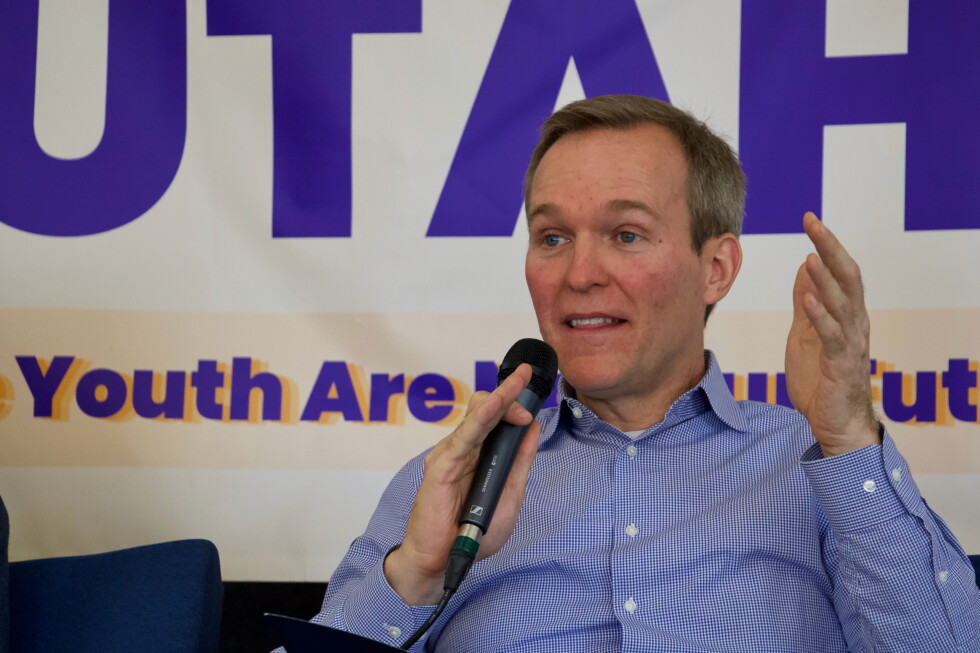
In the redefined Salt Lake City-centric 1st Congressional District, former Democratic U.S. Representative Ben McAdams is vying for a congressional comeback. He faces competition from state Sen. Nate Blouin, tax attorney Michael Farrell, and former lobbyist Liban Mohamed. McAdams has significantly outpaced his rivals in fundraising, with nearly three times Blouin’s total and a commanding lead over the rest.
Republican candidate Riley Owen stands unchallenged in this district. If these district lines had been in effect during the 2024 presidential election, former Vice President Kamala Harris would have secured a 60% majority.
The 2nd Congressional District, while largely unchanged, mirrors the old 1st District. Incumbent Republican U.S. Rep. Blake Moore is seeking a fourth term but is contested by state Rep. Karianne Lisonbee. Lisonbee outperformed Moore at the state party convention, although Moore secured his primary spot through petition signatures. Lisonbee has criticized Moore for his role in the “Better Boundaries” initiative that led to the 2018 redistricting law.
In the expansive new 3rd Congressional District, Republican U.S. Rep. Celeste Maloy is challenged by former state Rep. Phil Lyman as she seeks a second full term. Maloy’s district has shifted to include new regions along the Colorado border. She narrowly won over Lyman at the state convention, but not enough to prevent him from entering the primary.
For the new 4th Congressional District, Republican U.S. Rep. Mike Kennedy is running unopposed. This district includes much of Maloy’s current constituency on Utah’s western side, excluding the eastern part he has represented since 2025. Notably, Republican U.S. Rep. Burgess Owens has opted out of running for reelection.
Endorsements for all three incumbents seeking reelection have been given by Trump. In 2026, half of Utah’s state Senate seats and all state House seats are up for election, with Republicans holding a significant majority in both chambers.
Election Day Details
Polls will close at 8 p.m. MT on Tuesday, coinciding with 10 p.m. ET.
Ballot Insights
Vote results and winner announcements for the contested primaries in the U.S. House, state Senate, state House, and state Board of Education will be provided by The Associated Press.
Voter Participation
Registered voters can take part in the Democratic primary irrespective of their party affiliation, while only registered Republicans are eligible for the Republican primary. Voter registration can occur in person during early voting or on Election Day. Unaffiliated voters have the option to join the Republican Party at the polls on Election Day to vote in the primary.
Voter Statistics
As of June 16, Utah had approximately 2.1 million registered voters, including about 1 million Republicans, around 297,000 Democrats, and about 622,000 unaffiliated voters.
Voting Turnout
The 2024 Republican state primary saw about 427,000 votes cast. Democratic primary participation ranged from about 68,000 in the 2024 presidential primary to about 221,000 in 2020.
Early and Absentee Voting
Utah elections primarily occur by mail. By Thursday, around 163,000 ballots had been submitted for Tuesday’s primaries, with about 127,000 from Republicans, 32,000 from Democrats, and 2,900 from unaffiliated voters.
Results Release Schedule
Initial updates on early in-person and mail voting results are typically included in the first nightly update. In many counties, these results are released alongside in-person Election Day results.
Vote-Counting Duration
During the 2024 state primary, the first results were available at 10:03 p.m. ET, three minutes post-poll closure. The final update of the night was at 2:07 a.m. ET, with about 74% of votes counted. Over 90% of votes were tallied by June 27, two days after Election Day.
AP’s Declaration of Winners
The AP refrains from making projections and only declares a winner when the outcome is clear and irreversible. If races remain uncalled, the AP will cover important developments, clarifying its stance on winner declarations.
Recount Protocols
Recounts in Utah automatically occur only in tie situations. A candidate may request a recount if the margin is 0.25% or less of total votes. For elections with fewer than 400 votes, requests can be made if the margin is one vote. The AP might declare a winner in recount situations if the lead is insurmountable.
Counting Down to Midterms
As of Tuesday, the countdown stands at 133 days until the 2026 midterm elections.
___
Stay updated with the AP’s 2026 election coverage at https://apnews.com/projects/elections-2026/.