When allied forces can’t communicate clearly, the consequences can be deadly — as a tragic friendly fire incident earlier this year made painfully clear. Now, a major U.S. defense contractor is rolling out a new AI-powered communications tool designed to help troops in the field connect with coalition partners faster, more securely, and without the costly limitations of older systems.
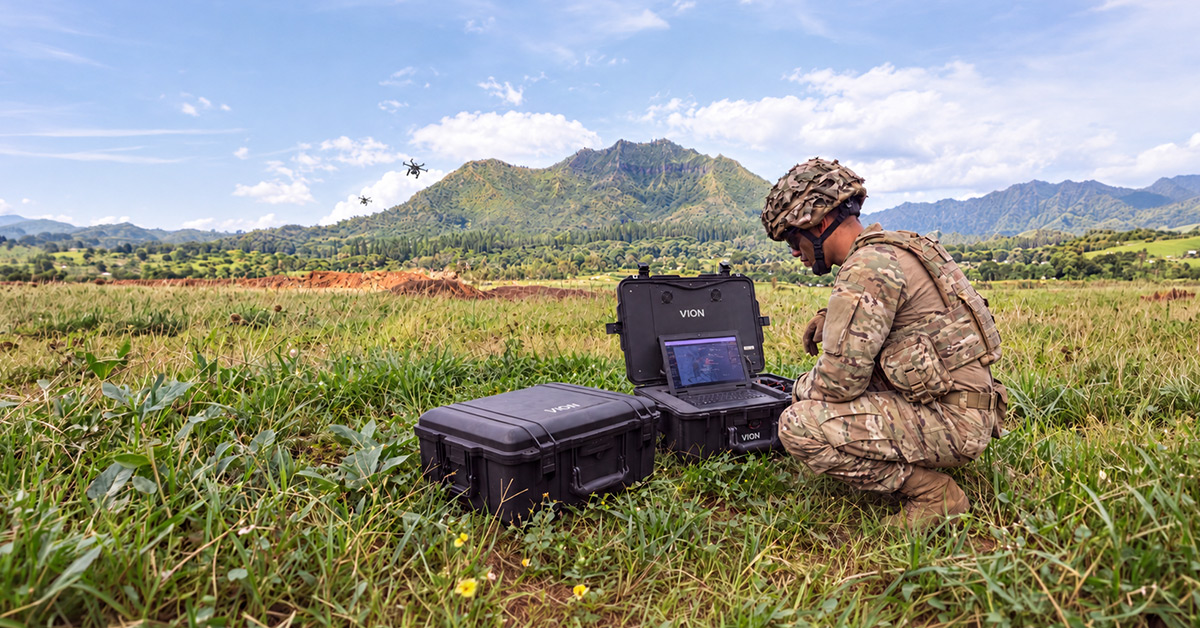
General Dynamics Information Technology unveiled the Vion on Thursday — a portable, suitcase-sized communications platform built around artificial intelligence and open architecture. The system is designed to give ground troops in remote locations the ability to quickly set up secure connections with command centers and coalition partners, regardless of what equipment or software those partners are already using.
What Vion Does
At its core, Vion is a Mission Partner Environment solution — a category of technology focused on enabling different military organizations to share information across their networks. The system can translate written messages, voice memos, and video content, while simultaneously adapting to or patching into existing connections. All of this happens under zero-trust cybersecurity protections, a security framework that requires continuous verification of every user and device on a network.
Jason Myers, vice president of defense agencies at General Dynamics Information Technology, told Military Times that one of Vion’s key advantages is flexibility. Unlike many existing platforms that are built around proprietary equipment and software — which can make upgrades expensive and complicated — Vion is designed to work with systems that military organizations already have in place.
“We wanted to provide an all-encompassing offering, but we didn’t want to lock somebody into an offering or not be able to use where they’ve already invested,”
Myers said.
He also emphasized that the system is built to evolve. Rather than requiring a full platform overhaul every time technology advances, Vion uses a modular design that allows individual components to be swapped out as better tools become available.
“What we wanted to do is say, ‘Yes, we’re going to use proven technologies,’ but as new things come out, we are absolutely ripping and replacing those, and how to do that securely, in that modular architecture, is really, really different than how things are being done today,”
Myers said.
The Push for Better Coalition Communications
The timing of Vion’s unveiling is no coincidence. The U.S. military has been under increasing pressure to improve how it shares information with allied forces — a challenge that became tragically visible in March when Kuwaiti air defenses mistakenly shot down three U.S. F-15E Strike Eagle fighter jets.
Jason Martin, Component Acquisition Executive for the Defense Information Systems Agency, referenced that incident directly when explaining why improved coalition communications infrastructure is so urgent.
“We’ve spent the past 50 years building siloed networks, siloed applications and siloed environments to collaborate internally with our own data. We can no longer do that,”
Martin said.
“We have to converge networks. We have to plug and play. We have to talk to one another … We have to operate and maintain command and control with a single voice.”
DISA has been working to address these gaps through a modernized framework called the Coalition Information Environment, or CIE — described as an architecture built on the principles of zero trust and data centricity. General Dynamics participated in a Joint Staff J6-led exercise called Olympus Fires, where DISA tested new approaches to strengthening the CIE.
At a panel discussion in June, U.S. Army Lt. Col. David Courter, DISA’s Combatant Command Integration and Plans chief, described the overarching goal of that effort as the ability to
“broker and federate our environments together without replicating a new environment every time.”
As for what’s next for Vion, Myers confirmed that GDIT is actively working through the acquisitions process but declined to identify potential customers. He did say, however, that he expects the system to have a lasting impact. In terms of service, he believes Vion will
“have a very long life in where it can add value to the mission.”