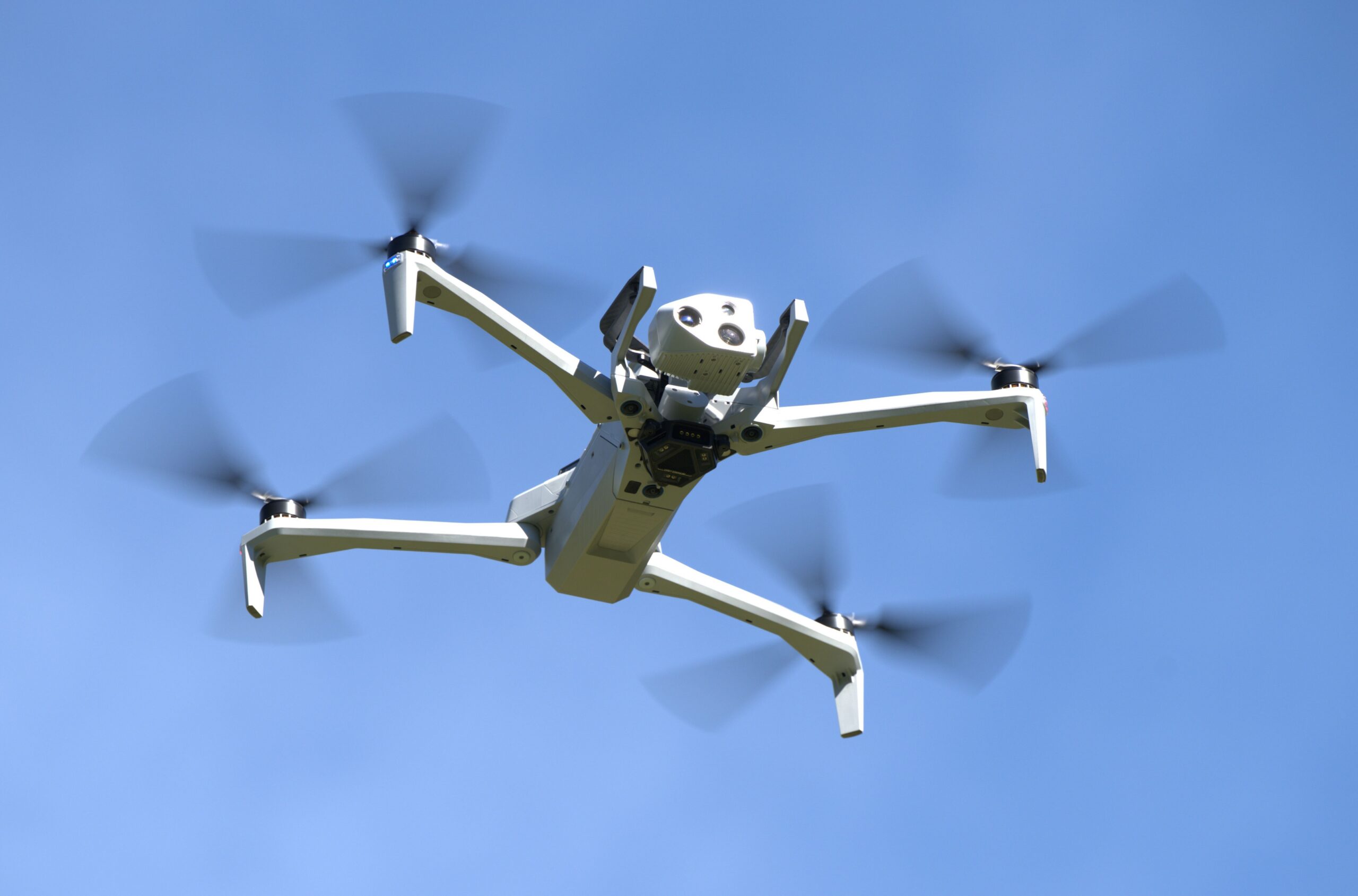
Drones are rapidly changing how law enforcement and military investigators do their jobs — and now the Air Force is making sure its agents know exactly how to use them. For the first time ever, the Air Force Office of Special Investigations has certified a group of special agents to both fly and teach others to operate the Skydio X10D, a small autonomous drone system with capabilities that could transform how investigators work in the field.
According to an official Air Force release, six AFOSI special agents completed an intensive weeklong training course at the office’s headquarters in Quantico, Virginia. They are now certified not only to fly the Skydio X10D, but also to train fellow agents — making them the first instructor cadre of their kind within the organization.
What the Training Involved
The certification course was divided into roughly equal parts classroom instruction and hands-on flight time. Agents completed about 16 hours of classroom work covering topics like airspace regulations, Federal Aviation Administration requirements, and mission planning. That was followed by approximately 16 hours of real-world flight scenarios tailored specifically to AFOSI’s mission needs.
The exercises were not routine. In one scenario, a student piloted the aircraft to approximately 400 feet in altitude to identify a vehicle’s license plate and track it for a full mile. In another, agents used the drone’s thermal imaging camera at night to locate a person concealed in a wooded area — the kind of capability that can make a meaningful difference in active investigations.
Special Agent Logan Trigg, assigned to the 2nd Field Investigations Squadron Technical Operations Program, described the scope of what agents gained from the course:
“We not only learned how to operate the drones, but also how to properly instruct other individuals on how to fly successfully to meet mission needs.”
Trigg is now tasked with training the entire 2nd FIS on drone operations, with the goal of getting all agents certified and ready to deploy the technology effectively on missions.
A “Train-the-Trainer” Approach
AFOSI is using a deliberate “train-the-trainer” model to scale the program. Rather than funneling every agent through a centralized course, the newly certified instructors will bring the capability directly to technical operation units across the service. The goal is to expand drone support for a wide range of operations — including surveillance, outdoor crime scene documentation, protective-service support, and any mission requiring aerial monitoring.
The groundwork for this program was laid back in 2024 at Detachment 111, based at Edwards Air Force Base in California. That unit served as an early pilot program to test whether small drone systems could realistically support AFOSI operations. Special Agent Scott Zawacki, AFOSI’s Technical Operations program manager, credited that work as essential to what came next:
“Det. 111 helped establish the proof of concept for a broader expansion.”
Although the Skydio X10D has not yet been used in an actual AFOSI case, the office has been conducting demonstrations to determine how the drone can best support field operations. Those demonstrations have focused on practical applications like crime scene documentation, reconnaissance, and spatial data collection.
What Comes Next
Five Skydio X10D units are scheduled to be fielded to AFOSI technical operations agents in January 2027. Between now and then, the newly certified instructor cadre will work to build out drone proficiency across the office’s investigative workforce.
This development fits within a broader push by the Air Force to integrate autonomous systems into its operations. In related military technology news, Northrop Grumman’s YFQ-48A completed its first fully autonomous flight just weeks after Air Force officials announced plans to have 500 autonomous aircraft in service by 2032. The service has also been making significant procurement moves, including a $2.38 billion contract to Boeing for 22 F-15EX fighters and a new full-rate order for Grey Wolf helicopters.
Meanwhile, questions about the limits of artificial intelligence in military contexts continue to surface, including debate over whether the Pentagon has moved away from AI-assisted polygraph analysis. Other recent video coverage includes a look at Ukraine’s emerging ‘Army of Robots’ concept, a retired Green Beret’s mine-clearing mission in Ukraine, and a new NORAD warning system contract.